

Why Does a Scale Measure Normal Force Instead of Weight?
A scale does not directly measure the force of gravity pulling on you. It measures how hard you and the scale push on each other. That contact force is the normal force.
When you stand still on a level floor, the normal force and your weight have the same size. That is why a scale reading usually seems to measure your weight.
But the scale is actually measuring something different.
Think about what the scale can actually feel
Gravity pulls on you whether a scale is there or not. The scale cannot reach out and measure Earth’s gravitational pull on you.
What can it detect?
Your interaction with the scale.
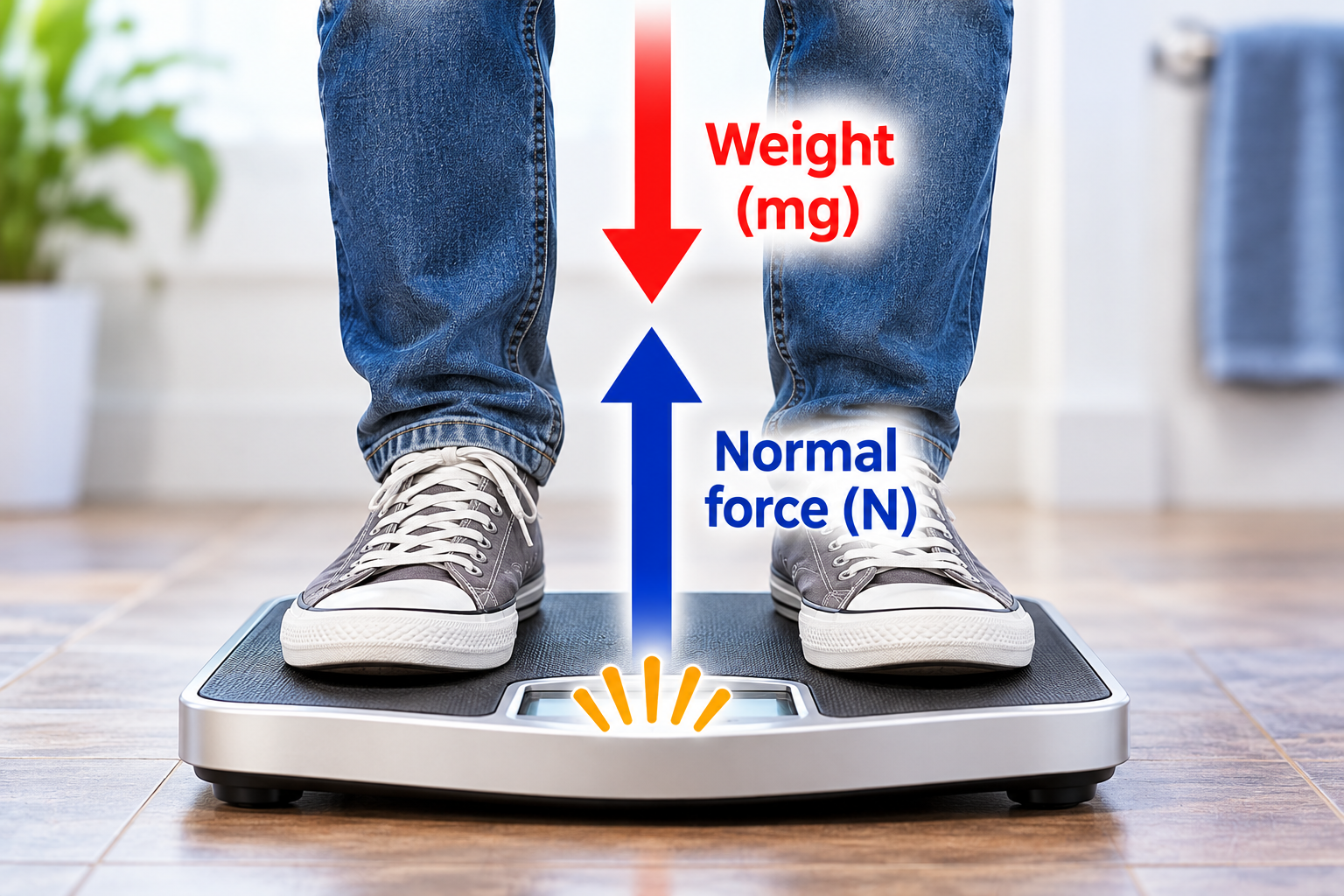
When you stand on a bathroom scale, you press down on it. The scale bends or compresses by a tiny amount, and its internal sensor uses that change to measure the contact force.
In other words, the scale is really answering this question:
How hard are you pressing on me right now?
By Newton’s third law, as you push down on the scale, the scale pushes upward on you with an equal-size force. That upward force on you is the normal force.
Then why does the scale show pounds or kilograms?
Most bathroom scales are designed to turn their force measurement into a familiar number.
When you are standing still, your acceleration is zero. The upward normal force balances the downward force of gravity:
N = mg
So under ordinary conditions, the scale can use the measured normal force to calculate and display the mass or weight value you expect to see.
That works because, while you are standing still, the normal force and your weight have the same size.
But they are still two different forces.
Gravity comes from Earth pulling on you. The normal force comes from the scale pushing on you.
How can we tell the scale is measuring the normal force?
Change the contact force, and the scale reading changes.
Imagine standing on a scale in an elevator. If the elevator accelerates upward, the scale must push harder on you, so its reading increases. If the elevator accelerates downward, it pushes less strongly, so the reading decreases.
Earth’s gravitational pull on you has barely changed.
The contact force has.
That is the clue.
What if there is no contact force?
Free fall gives us an even clearer example.
Imagine you and the scale falling together. You would no longer press against the scale in the usual way, so the scale could read zero.
But gravity would still be pulling on you.
Your weight would not be zero.
The normal force would be.
That tells us what the scale was measuring all along.
The main idea
A scale measures the contact force between you and the scale, not gravity directly.
When you are standing still, that contact force happens to have the same size as your weight. That is why the difference is so easy to miss.
If you remember one idea, make it this:
A scale reading comes from how hard the scale is pushing on you, not from directly measuring how hard Earth is pulling on you.
Want to understand the forces behind the reading?
This question is one small part of a bigger idea: how forces work together in Newton’s laws and free-body diagrams.
The Physics Sensei Newton’s Laws and Free-Body Diagrams Review can help you put weight, normal force, and the other forces you encounter into the bigger picture.
Want to go deeper?
Want more practice with forces, Newton’s laws, and free-body diagrams?
Choose the review that matches your course and the time you have:

0 Comments