

Foundational Physics
Short Answer: Acceleration becomes zero at terminal velocity because air resistance balances the object’s weight, making the net force zero even though the object continues moving.
Sensei’s Warning
Zero acceleration does not mean zero velocity. It means velocity is no longer changing.
How Can Something Keep Falling Without Accelerating?
Imagine a skydiver jumping from an airplane.
At first, gravity pulls the skydiver downward, causing their speed to increase.
As they fall faster, air resistance becomes stronger.
Eventually, air resistance grows large enough to balance the downward pull of gravity.
At that moment, the skydiver’s acceleration becomes zero.
But the skydiver does not stop falling.
They continue moving downward at a constant speed called terminal velocity.
What Happens to the Forces?
Two main forces act on a falling skydiver:
- Weight: Gravity pulls downward.
- Air resistance: Drag pushes upward against the falling motion.
Initially, weight is greater than air resistance, so the skydiver accelerates downward.
As the skydiver speeds up, drag increases.
At terminal velocity, these two forces become equal in magnitude and opposite in direction, approximately neglecting buoyancy.
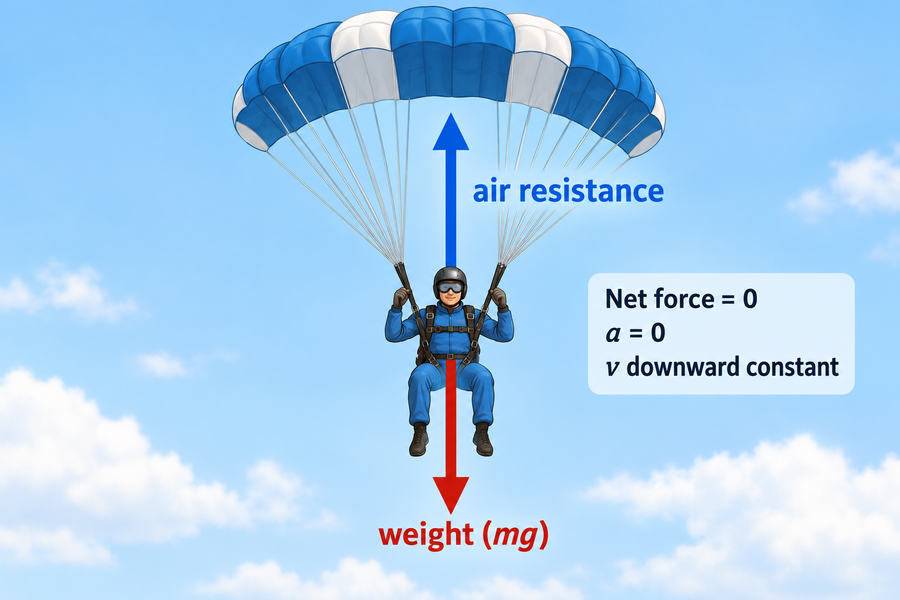
When the forces balance, there is no net force to change the skydiver’s velocity.
Does Zero Net Force Mean No Motion?
No. This is a common physics misconception.
Newton’s First Law tells us that an object can remain at rest or continue moving with constant velocity when the net force is zero.
At terminal velocity, the skydiver is doing the second.
Their velocity is not zero. Their acceleration is zero.
What Happens When the Parachute Opens?
Opening the parachute greatly increases air resistance.
For a short time, the upward drag force can become greater than the skydiver’s weight.
The net force then points upward, so the skydiver accelerates upward—even while still moving downward.
In other words, they slow down.
As their speed decreases, drag decreases until the forces balance again.
The skydiver then descends at a new, much lower terminal velocity.
The Key Idea to Remember
Acceleration describes a change in velocity, not whether something is moving.
At terminal velocity, the forces balance, the acceleration is zero, and the falling object keeps moving at a constant velocity.
When This Breaks
The simple model assumes approximately steady air conditions and constant body position. Changes in posture, air density, or parachute configuration can change drag and cause the skydiver to accelerate again.
For a related explanation of why drag grows as speed increases, see Why Does Air Resistance Increase With Speed?
Continue with the Newton’s Laws and Free-Body Diagrams Unit Review
Choose the physics course that matches yours, then select the review depth that fits your time.
Foundational Physics
Algebra-Based Physics
Calculus-Based Physics
Reviewed by Physics Sensei


0 Comments