

Foundational Physics
Short Answer: An object needs an inward net force to move in a circle because its velocity is constantly changing direction, even if its speed stays the same.
Sensei’s Warning
Constant speed does not mean constant velocity. Velocity includes direction, so an object moving around a circle is accelerating even if it never speeds up or slows down.
What Would Happen Without an Inward Force?
Imagine swinging a ball attached to a string around in a circle.
The ball keeps turning because the string pulls it inward.
Now imagine the string suddenly breaks.
Would the ball keep moving around the circle?
No. Without the inward pull, it would leave the circular path and continue in a straight line, tangent to the circle at the point of release, assuming no other forces change its motion.
That gives us the central idea:
The inward force is what keeps the object's path bending.
Why Isn't Constant Speed Enough?
Suppose the ball moves around the circle at exactly the same speed.
At one moment, it is moving toward the left. A little later, it may be moving upward.
Its speed hasn't changed, but its direction has.
And because velocity includes direction, its velocity has changed.
A change in velocity means acceleration. According to Newton's Second Law, acceleration requires a net force.
For motion around a circle at constant speed, that net force must point toward the center.
Which Way Do Velocity and Force Point?
At any point on a circular path:
- Velocity points along the tangent to the circle, in the direction the object is moving.
- Net force points inward, toward the center, when the object moves in a circle at constant speed.
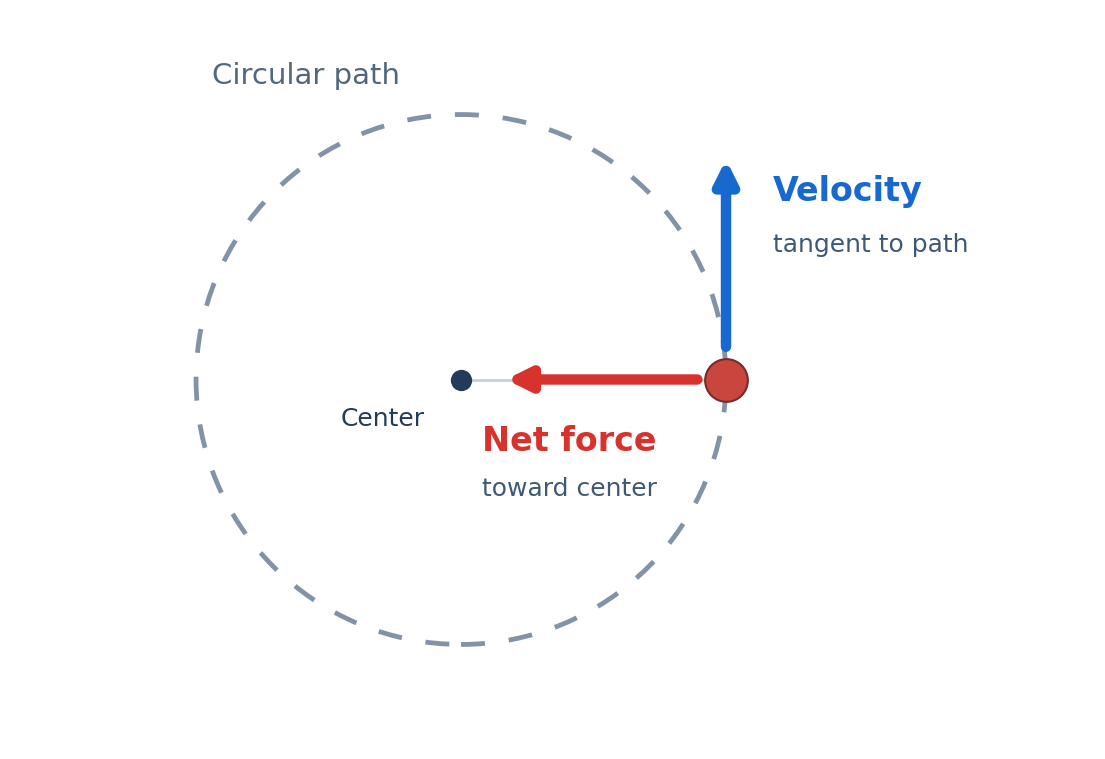
The inward force does not need to push the object forward to keep it moving around the circle. It continuously changes the direction of the object's velocity.
Where Does the Inward Force Come From?
The required inward net force can come from different physical interactions.
For a ball moving on a circular path, the string's tension can provide the inward pull.
For a car turning on a flat road, friction between the tires and road can provide the inward force.
For a satellite orbiting Earth, gravity provides the inward force needed to keep changing its direction.
In each situation, a force must act inward to bend the object's path.
What Happens If the Inward Force Disappears?
The object does not suddenly move outward along a radial line.
Instead, it continues along the direction of its velocity at that instant, unless another force changes its path.
This is why a ball released from a circular path initially moves along a tangent rather than flying directly away from the center.
The Key Idea to Remember
An object needs an inward net force to keep turning, not necessarily to keep its speed constant.
Without that inward force, the object cannot continue following the same circular path.
When This Breaks
This simple picture assumes motion in a circle at constant speed. If the object's speed also changes, acceleration can have a tangential component in addition to the inward component.
Continue with the Uniform Circular Motion Unit Review
Choose the physics course that matches yours, then select the review depth that fits your time.
Foundational Physics
Algebra-Based Physics
Calculus-Based Physics
Reviewed by Physics Sensei


0 Comments