

Foundational Physics
Short Answer: Centripetal force is not a separate type of force. It is the name given to the net inward force needed for circular motion, supplied by real forces such as tension, friction, or gravity.
Sensei’s Warning
Never add an extra “centripetal force” arrow to a free-body diagram. Identify the actual physical forces acting on the object, then determine how their combined effect points inward.
What Does “Centripetal” Actually Mean?
The word centripetal means “toward the center.”
When an object travels in a circle, the direction of its velocity continually changes.
That change requires acceleration, and acceleration requires a net force.
For circular motion at constant speed, the net force points toward the center of the path.
We call this the centripetal force.
But this name describes what the net force does. It does not introduce another physical interaction.
Where Does the Inward Force Come From?
Imagine three situations:
- A ball on a string: Tension pulls the ball inward.
- A car turning on a flat road: Static friction between the tires and road provides the inward force.
- A satellite orbiting Earth: Gravity supplies the inward force.
These are different physical interactions, but they can all produce circular motion.
There is no need to add another force called “centripetal force.”
Why Does This Matter for Free-Body Diagrams?
Consider a car following a circular path on a flat, level road.
The car experiences weight downward, a normal force upward, and static friction horizontally toward the center of the turn.
For a level road with no vertical acceleration, weight and normal force balance.
The horizontal static friction force provides the required inward net force.
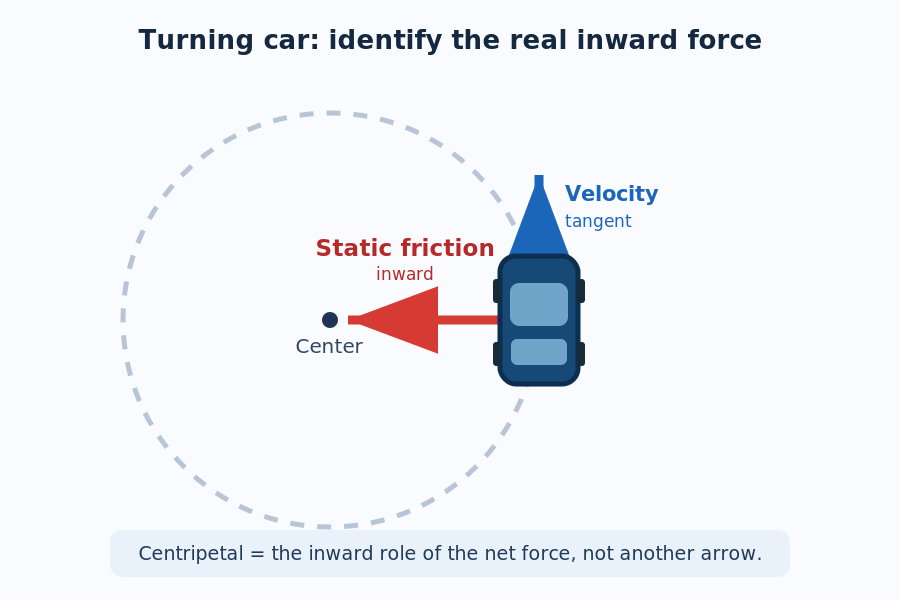
If you draw another arrow labeled “centripetal force” in addition to friction, you have counted the same inward effect twice.
The correct approach is to draw the real forces once and identify their net inward component.
Can Several Forces Produce Centripetal Force Together?
Yes.
Sometimes more than one force contributes to the required inward net force.
For example, on a banked road, the normal force can have an inward component, and friction may also contribute depending on the speed and conditions.
It is their combined inward effect that matters.
Centripetal force is the name for that net inward result—not another force to add.
The Key Idea to Remember
Centripetal force describes the inward net force responsible for circular motion. It is not an extra force.
First identify the real forces. Then determine which force or combination of forces produces the necessary inward net force.
When This Breaks
The simple description of a purely inward net force assumes circular motion at constant speed. If the object’s speed changes, the net force can also have a tangential component.
Continue with the Uniform Circular Motion Unit Review
Choose the physics course that matches yours, then select the review depth that fits your time.
Foundational Physics
Algebra-Based Physics
Calculus-Based Physics
Reviewed by Physics Sensei

0 Comments