

Foundational Physics
Short Answer: Centripetal acceleration changes the direction of an object’s velocity, not its magnitude, because it acts perpendicular to the direction of motion.
Sensei’s Warning
Acceleration does not always mean speeding up or slowing down. An object can accelerate simply because its direction of motion is changing.
How Can Something Accelerate Without Speeding Up?
Imagine a car traveling around a circular track.
The driver keeps the speedometer reading at exactly 40 mph throughout the turn.
Is the car accelerating?
Yes.
Even though its speed remains constant, the car is continuously changing direction.
Acceleration describes a change in velocity, and velocity includes both speed and direction.
The car is therefore accelerating every moment it follows the circular path, even though it never speeds up.
Which Way Does Centripetal Acceleration Point?
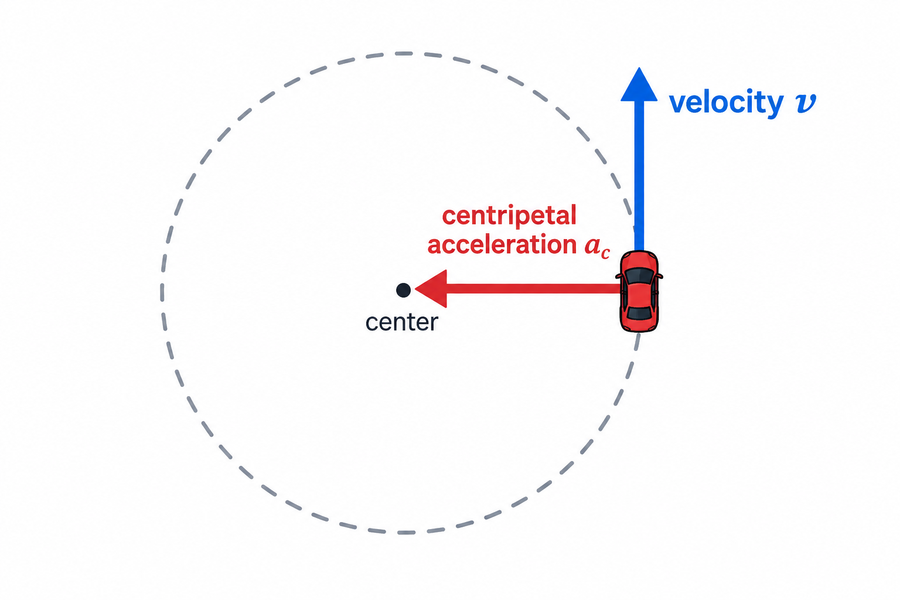
For an object moving around a circle at constant speed, two directions are important:
- Velocity points tangent to the circular path, in the direction of motion.
- Centripetal acceleration points inward, toward the center of the circle.
These directions are perpendicular.
This is the key to understanding why centripetal acceleration does not change the object’s speed.
Why Does Perpendicular Acceleration Change Direction Instead of Speed?
Think about pushing a moving object.
If you push in the direction it is already moving, you can increase its speed.
If you push directly against its motion, you can decrease its speed.
But if the resulting acceleration is perpendicular to its velocity, it continually redirects the motion rather than increasing or decreasing the speed.
That is what happens in uniform circular motion.
Centripetal acceleration keeps redirecting the velocity toward the next tangent of the circular path.
The velocity changes direction continuously, but its magnitude remains constant.
Does This Mean the Car Experiences No Force?
No.
A car traveling around a flat circular track needs a net inward force. Static friction between the tires and road can provide that force.
The inward net force produces the centripetal acceleration.
The car can therefore experience a nonzero net force and acceleration while maintaining a constant speed.
This is different from straight-line motion at constant velocity, where the net force is zero.
What If the Car Starts Speeding Up During the Turn?
Then its acceleration has two components.
The inward component changes the direction of the velocity.
A tangential component changes the speed.
When both are present, the car can turn and speed up—or turn and slow down—at the same time.
But if the car maintains constant speed around a circular path, its acceleration is entirely inward.
The Key Idea to Remember
Centripetal acceleration changes where the velocity points, not how large the velocity is.
An object can accelerate continuously while moving at constant speed because acceleration is not limited to changes in speed.
When This Breaks
The constant-speed conclusion applies when acceleration is entirely perpendicular to velocity. If acceleration also has a component along or opposite the direction of motion, the object’s speed changes.
Continue with the Uniform Circular Motion Unit Review
Choose the physics course that matches yours, then select the review depth that fits your time.
Foundational Physics
Algebra-Based Physics
Calculus-Based Physics
Reviewed by Physics Sensei

0 Comments