

Foundational Physics
Short Answer: A projectile keeps moving forward while falling because it already has horizontal velocity, and gravity accelerates it downward without changing that horizontal velocity when air resistance is neglected.
Sensei’s Warning
Gravity does not pull the projectile backward. In the ideal projectile-motion model, gravity acts downward, so falling does not automatically mean slowing down horizontally.
Why Doesn’t a Falling Ball Stop Moving Forward?
Imagine a tennis ball rolling across a table and then leaving the edge.
While the ball is on the table, it moves horizontally.
Once it passes the edge, the table no longer supports it, and gravity causes it to fall.
But something important happens:
The ball does not lose its horizontal motion when it leaves the table.
It continues traveling forward while falling downward.
This is why the ball follows a curved path instead of dropping straight down from the table’s edge.
What Keeps the Ball Moving Horizontally?
The ball already has horizontal velocity when it leaves the table.
According to Newton’s First Law, an object does not need a continuing horizontal force to maintain constant horizontal velocity.
It needs a net horizontal force to change that velocity.
In the ideal projectile-motion model, air resistance is neglected.
That means there is no horizontal force acting on the ball after it leaves the table.
Its horizontal velocity therefore remains constant.
The ball continues moving forward because of its existing motion, not because something keeps pushing it forward.
What Does Gravity Change?
Gravity pulls the ball downward.
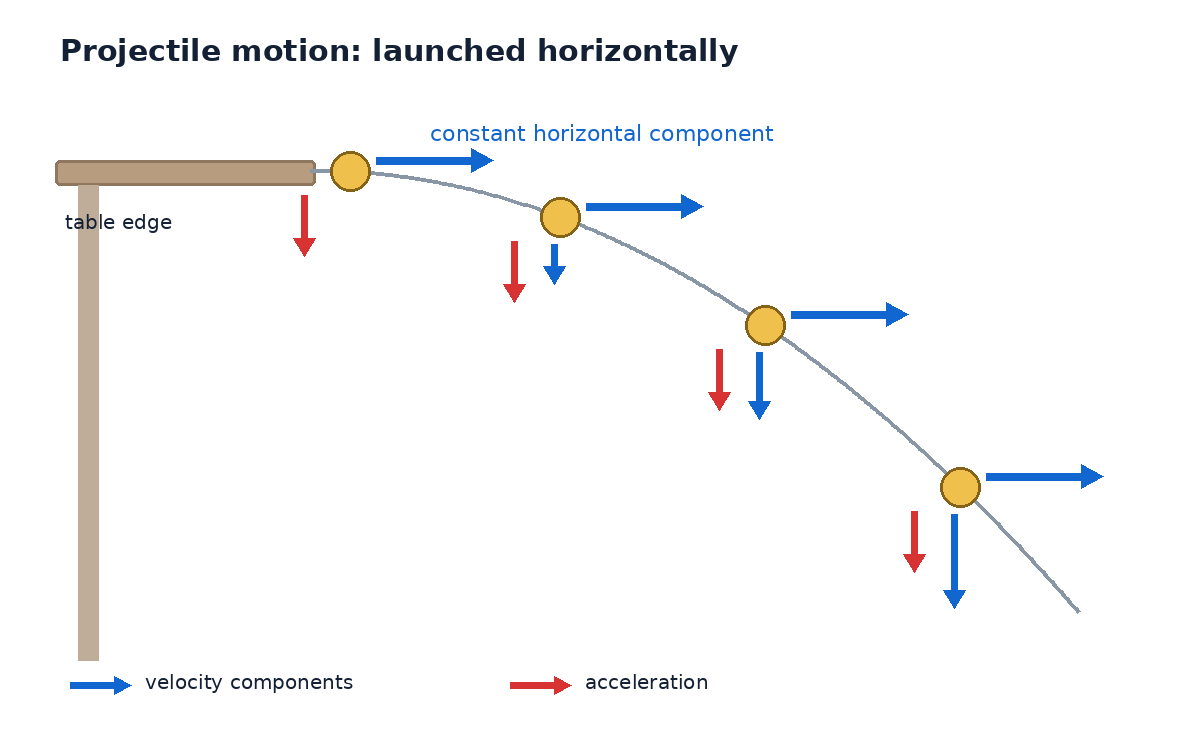
As the ball falls, its downward velocity increases.
Meanwhile, its horizontal velocity stays the same.
The two changes combine to produce the familiar curved trajectory.
Why Does the Path Curve?
Think about what happens during each short interval of time.
The ball moves forward because of its horizontal velocity.
At the same time, gravity makes it fall farther downward.
During the next interval, the ball continues moving forward while its downward velocity becomes larger.
As time passes, its motion becomes increasingly downward, even though its horizontal velocity has not changed.
The result is a parabolic trajectory.
The path curves because the horizontal and vertical parts of the motion happen together.
What If You Simply Drop the Ball?
Imagine two identical balls starting at the same height.
You release one without giving it any horizontal velocity.
You launch the other horizontally from the same height.
Ignoring air resistance, both have the same initial vertical velocity—zero—and the same downward acceleration.
Therefore, they fall the same vertical distance during the same time interval.
If they start simultaneously, they reach the ground at the same time, assuming the ground is level.
The horizontally launched ball travels farther forward, but it does not fall more slowly.
Does Gravity Ever Stop the Forward Motion?
Not in the ideal model.
Gravity acts vertically, so it does not reduce the horizontal velocity.
In the real world, air resistance can oppose the projectile’s motion and reduce its horizontal speed.
That is why the ideal projectile model is an approximation rather than a description of every real situation.
The Key Idea to Remember
A projectile continues forward because it already has horizontal velocity. Gravity makes it fall, but it does not remove that horizontal motion when air resistance is neglected.
When This Breaks
The constant-horizontal-velocity explanation assumes negligible air resistance and approximately uniform gravity. With appreciable aerodynamic forces, horizontal velocity may change and the trajectory may differ from the ideal parabola.
Continue with the Projectile Motion Unit Review
Choose the physics course that matches yours, then select the review depth that fits your time.
Foundational Physics
Algebra-Based Physics
Calculus-Based Physics
Reviewed by Physics Sensei


0 Comments