

Foundational Physics
Short Answer: Electric field lines never cross because the electric field at a point has one definite direction, provided the field is nonzero. A field line is drawn so its tangent points in that direction. If two field lines crossed at different angles, they would assign two directions to the same electric field at the crossing—which is impossible.
Sensei’s Warning
Field lines are a way to picture an electric field, not physical strands in space. Their direction shows the field direction, and the spacing is used to suggest field strength. Do not interpret two lines crossing as two separate electric forces acting on the same test charge.
What does a field line tell you?
Imagine placing a tiny positive test charge near a charged object. The electric field at that location tells you the direction of the electric force on the positive test charge.
When we draw electric field lines, we make each line tangent to that direction at every point along it. The line may curve because the field direction changes from one place to the next.
But at one specific point, the electric field cannot point in two different directions at once.
What would happen if two lines crossed?
Picture two field lines intersecting like the letter X. One line goes upward and to the right; the other goes downward and to the right.
At the crossing, the tangent to the first line indicates one electric-field direction, while the tangent to the second indicates a different direction. A positive test charge placed there would supposedly have to accelerate in both directions as its single net electric-force direction.
That is the contradiction: the net electric field has only one direction at a point where it is nonzero. So distinct field lines cannot cross at different angles.
What about fields created by several charges?
Every charge contributes to the electric field at a location. But those contributions combine as vectors to produce one net electric field.
Field-line drawings represent that net field, not one independent set of lines for each charge overlaid as if each set were the final result. An overlay of individual-charge diagrams can show curves crossing; those overlapping curves are not the field lines of the combined field.
What about a point where the field is zero?
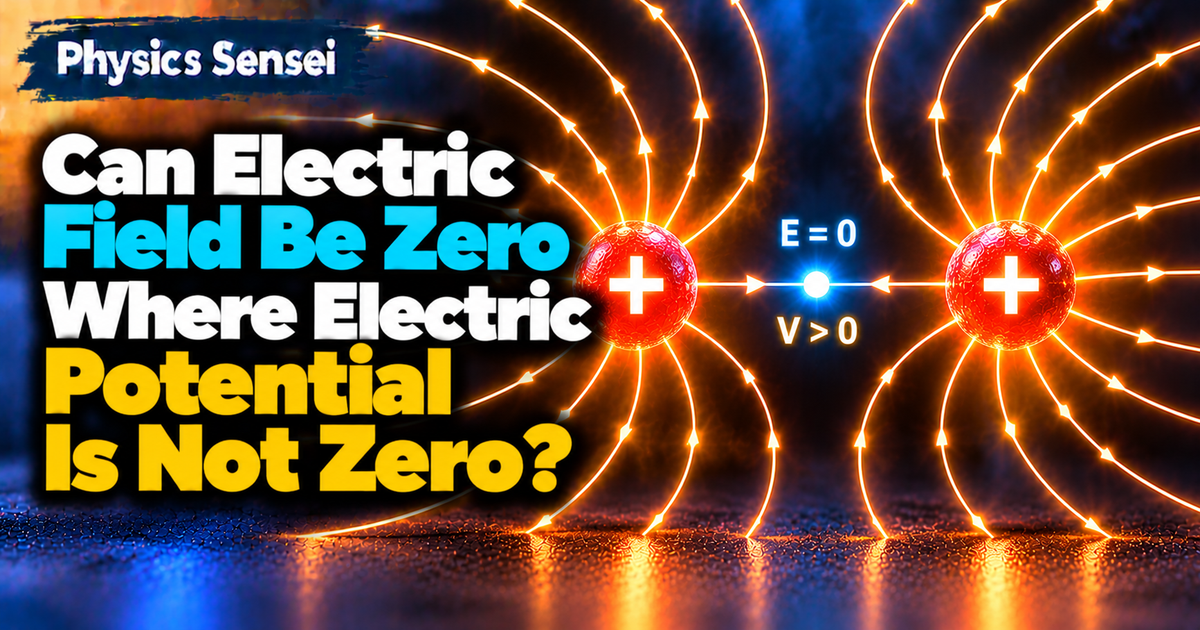
At some locations, the electric fields produced by different charges cancel exactly. The net electric field there is zero, so it has no defined direction.
At such a point, the usual tangent-direction rule does not pick out a direction. That is a special limitation of a field-line picture, not permission to draw two ordinary field lines crossing with different nonzero electric-field directions.
The takeaway
Electric field lines cannot cross because the electric field has one net direction at each point where it is nonzero. The tangent to a field line must agree with that direction.
When This Breaks
The rule applies to conventional electric-field lines for a single, well-defined vector field. It does not mean that every diagram containing arrows or paths must avoid intersections. Curves representing different fields, lines projected from a three-dimensional drawing onto a flat page, or sketches of separate electric-field contributions may appear to cross.
Also, the electric field can vanish at certain points, where its direction is undefined. These qualifications do not change the usual rule for correctly drawn field lines representing a nonzero net electrostatic field.
Keep Exploring: Electric Fields
Want to practice interpreting electric field direction and field-line diagrams? Choose the Physics Sensei review that matches your course and how much time you have.
Foundational Physics
Algebra-Based Physics
Calculus-Based Physics
Reviewed by Physics Sensei
Still stuck? Get unstuck. Choose the review that matches your course and the time you have.

0 Comments