

Foundational Physics
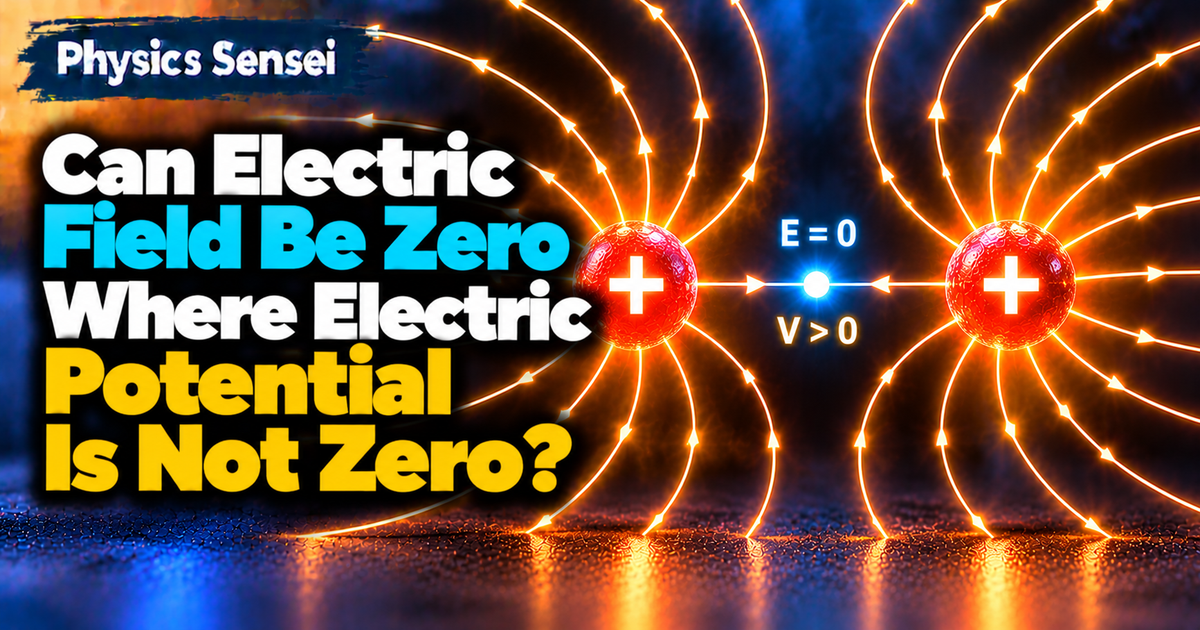
Short Answer: Yes. Electric potential can be zero at a point even when the electric field is not zero. Potential is a value; electric field depends on how that value changes from place to place. For example, halfway between equal positive and negative point charges, the two potentials cancel to zero, but their electric fields point in the same direction and add.
Sensei’s Warning
Do not interpret V = 0 as E = 0. Potential is a scalar and depends on the chosen zero reference; the electric field is a vector and does not disappear just because potential has a value of zero.
How can zero potential still have an electric field?
Think of electric potential as a number assigned to each location. Choosing a place where that number is zero tells you the potential there, not whether nearby locations have the same potential.
The electric field describes how potential changes with position. If the potential changes as you move away from a zero-potential point, the electric field can still be nonzero at that point.
What happens between a positive and a negative charge?
Imagine two point charges with equal magnitudes and opposite signs, placed the same distance from a midpoint. Using zero potential at infinity, the positive charge contributes a positive potential at that midpoint and the negative charge contributes an equally large negative potential.
Those potential contributions cancel, so the total potential is zero.
But electric fields have direction. At the midpoint, the field from the positive charge points away from it, toward the negative charge. The field from the negative charge also points toward the negative charge. The two electric fields add rather than cancel.
Does zero potential mean zero force on a test charge?
No. A positive test charge placed at that midpoint experiences a force in the direction of the nonzero net electric field. The fact that the potential is zero does not eliminate the local force.
That is because force depends on the electric field, not on the numerical value chosen for potential at one location.
Does the zero of potential matter?
Yes—for the value of potential. We can choose a different reference and add the same constant to the potential everywhere. That changes which locations are labeled zero, but it does not change potential differences or the electric field.
This is another reason a zero value of electric potential cannot, by itself, tell you that the electric field vanishes.
The takeaway
Zero electric potential is not the same as zero electric field. Potential contributions may cancel while field contributions reinforce one another. Look at the change in potential—or the vector sum of the fields—not just the potential value at one point.
When This Breaks
The dipole midpoint example assumes equal and opposite point charges and the familiar reference where potential approaches zero far away. Different charge arrangements may produce different fields and potential values.
Also, zero electric field at a point does not require zero potential there. In electrostatic equilibrium the field can vanish within a conductor even while the conductor has a nonzero constant potential. These are different conditions, not interchangeable rules.
Keep Exploring: Electric Fields
Want to connect potential, field direction, and superposition? Choose the Physics Sensei Electric Fields Unit Review that matches your course and the time you have.
Foundational Physics
Algebra-Based Physics
Calculus-Based Physics
Reviewed by Physics Sensei
Still stuck? Get unstuck. Choose the review that matches your course and the time you have.

0 Comments