

Foundational Physics
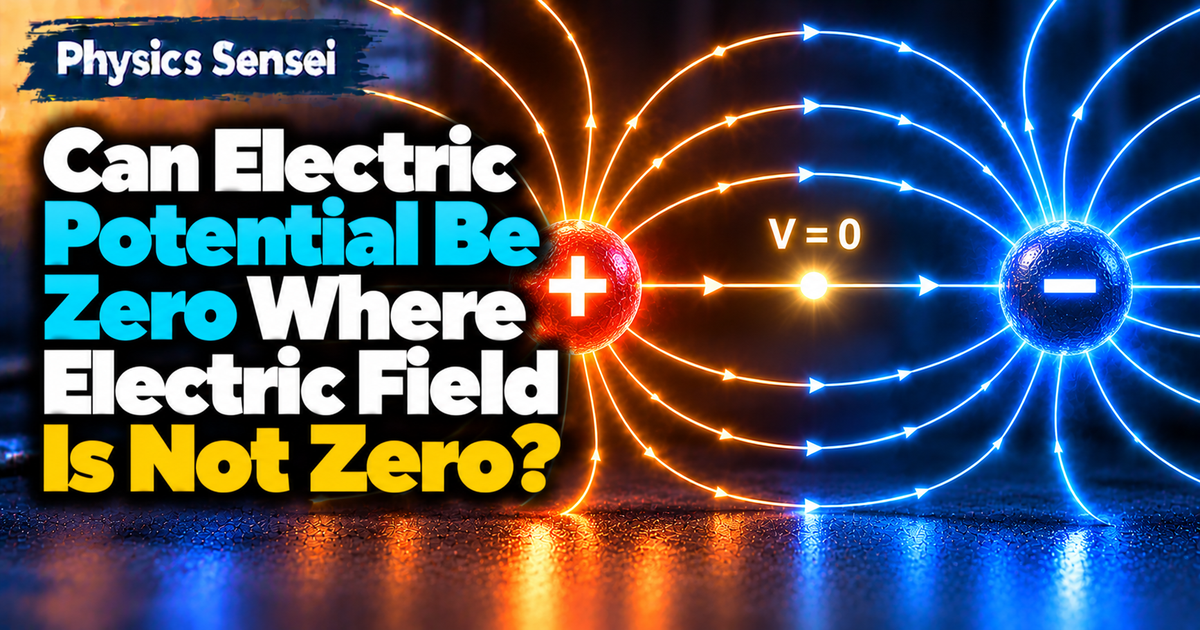
Short Answer: Yes. The electric field can be zero at a point while the electric potential there is not zero. Electric field contributions are vectors and can cancel because they point in opposite directions. Electric potential contributions are scalars and may add to a nonzero value. Halfway between two identical positive point charges, the net field is zero, but the electric potential is positive when we choose zero at infinity.
Sensei’s Warning
Do not treat E = 0 as meaning V = 0. Zero electric field means no net electric force on a test charge at that point. It does not tell you the numerical value of potential, which also depends on the chosen reference.
How can the electric field be zero without the potential being zero?
The electric field tells you the direction and strength of the net force per unit charge. When different contributions to the field are equal in magnitude and opposite in direction, they cancel.
Electric potential is different: it is a single number assigned to a location. Contributions from positive charges are positive when the reference is zero at infinity. Those scalar contributions can add even if the vector fields cancel.
What happens between two positive charges?
Imagine two identical positive point charges placed the same distance to either side of a midpoint. At the midpoint, the electric field from the left charge points right, while the field from the right charge points left.
Because the charges and distances match, the fields have equal magnitudes. They cancel exactly at the midpoint.
Now consider potential. Each positive charge contributes a positive potential at the midpoint, assuming zero potential at infinity. Potential has no direction, so the two contributions add. The total potential is positive, not zero.
Would a positive test charge feel a force at the midpoint?
At that exact midpoint, an ideal positive test charge experiences zero net electric force, because the net electric field there is zero.
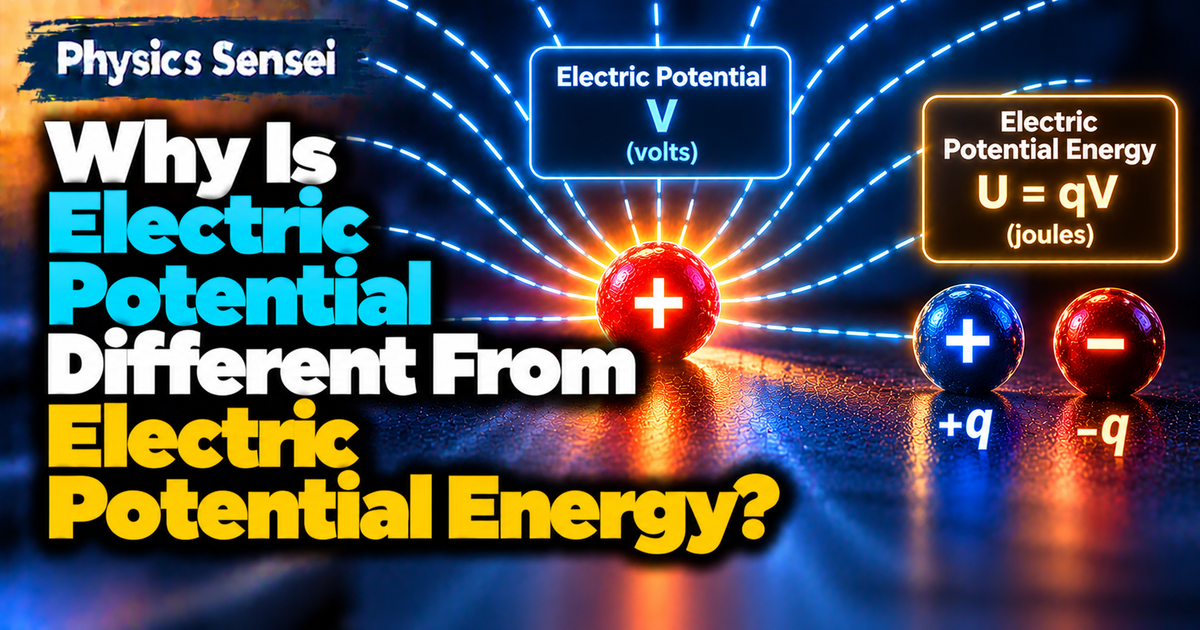
That does not mean the charge has zero electric potential energy. Its potential energy depends on the potential and its own charge. And if it moves slightly away from the midpoint, the fields generally stop canceling, so a net force can appear.
Does zero field mean potential is constant everywhere?
No. Zero field at one point says the potential has no spatial slope at that point in electrostatics. Nearby positions may have different potentials.
By contrast, when the electric field is zero throughout an entire connected region, the electric potential is constant throughout that region. That constant need not be zero.
The takeaway
Fields can cancel as vectors even when potentials add as scalars. At the midpoint between two identical positive point charges, E = 0 while V is positive using the usual zero-at-infinity reference.
When This Breaks
The two-charge midpoint result assumes identical positive point charges placed symmetrically, with no other charges or applied fields affecting the location. Different arrangements may produce a different net electric field.
The potential’s numerical value also depends on the reference chosen. You may add a constant to the potential everywhere without changing the electric field. So “nonzero potential” is reference-dependent, while the physical statement that the field vanishes at the midpoint is not.
Keep Exploring: Electric Fields
Want to understand electric-field superposition and how forces combine? Choose the Physics Sensei Electric Fields Unit Review for your course and the amount of time you have.
Foundational Physics
Algebra-Based Physics
Calculus-Based Physics
Reviewed by Physics Sensei
Still stuck? Get unstuck. Choose the review that matches your course and the time you have.
0 Comments