

Foundational Physics
Short Answer: Yes. An object can have zero velocity at a single instant while still having nonzero acceleration, because acceleration tells you how the velocity is changing, not how large the velocity is at that moment.
Sensei’s Warning
A velocity of zero at one instant does not mean the object is not accelerating. Zero velocity and zero acceleration are not the same idea.
How Can That Happen?
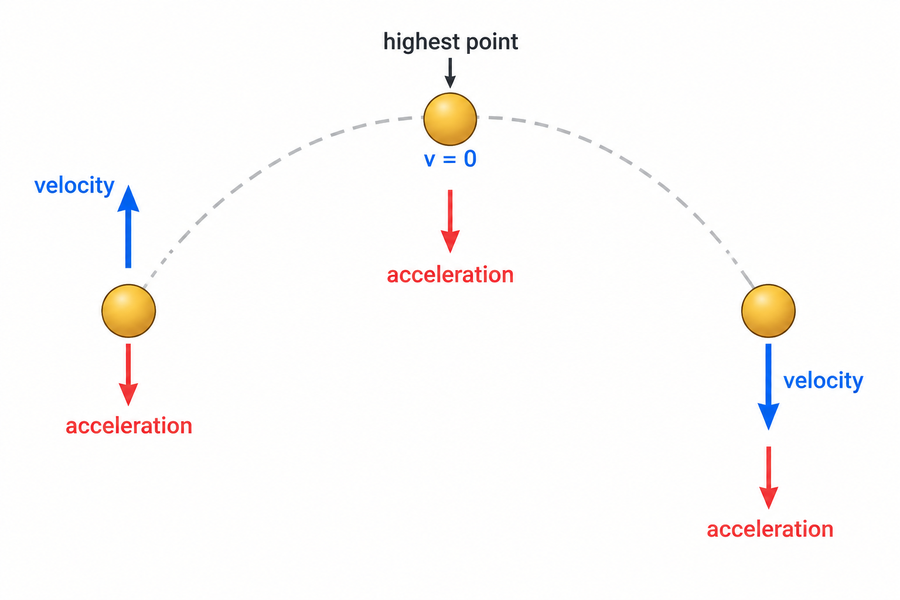
Imagine throwing a ball straight upward.
As the ball rises, its velocity points upward.
Gravity pulls downward the entire time, so the ball’s acceleration is downward the entire time.
Eventually the ball reaches its highest point.
At that instant, the upward motion has just finished and the downward motion has not yet fully begun.
So the ball’s instantaneous velocity is zero.
But gravity has not turned off.
The ball still has a downward acceleration at that exact moment.
Why Is the Highest Point So Important?
The highest point is the clearest example because students often think: “If the ball stops for a moment, then acceleration must be zero too.”
That is the misconception.
At the top, velocity = 0 while acceleration is not zero.
The velocity is zero because the direction of motion is changing from upward to downward.
The acceleration is still downward because gravity keeps acting continuously.
What Is Acceleration Really Telling You?
Acceleration tells you how velocity changes with time.
That means it can be nonzero even when the current velocity happens to be zero.
At the top of the motion, the ball is about to start moving downward faster and faster.
That future change is exactly what the downward acceleration is telling you.
So zero velocity does not mean “nothing is happening.”
It means the object is at a turning point.
Does Zero Velocity Mean the Object Is at Rest?
Not necessarily.
“At rest” usually means the object remains with zero velocity for some interval of time.
But in this case, the ball has zero velocity only for an instant.
A moment earlier it was moving upward.
A moment later it is moving downward.
So it is better to say the ball has momentary zero velocity, not that it is simply at rest in the ordinary sense.
Another Way to Think About It
Suppose acceleration were zero at the highest point.
Then there would be no downward pull changing the motion.
The ball would not reverse direction and come back down the way it actually does.
The fact that the ball immediately begins moving downward tells us the acceleration never disappeared.
The Key Idea to Remember
Velocity can be zero at an instant while acceleration is still nonzero.
That happens whenever an object reaches a turning point while a force continues to act, such as a ball thrown straight upward under gravity.
When This Breaks
This simple explanation assumes the object is moving under a continuing nonzero acceleration, like gravity near Earth’s surface. If the net force really becomes zero at the turning point, then the acceleration would also be zero.
Continue with the Motion in One Dimension Unit Review
Choose the course that matches yours, then select the review depth that fits your time.
Foundational Physics
Algebra-Based Physics
Calculus-Based Physics
Reviewed by Physics Sensei
0 Comments