

Physics Problem Solving: Why Students Should Not Calculate Too Early
Physics problem solving often breaks down when students start calculating too early. I recently asked one of my students to throw away her calculator. She looked at me appalled.
Then I said, “Don’t do it literally. You will need it later.” But that was my point. Later.
Here is what happened.
Last week, I was talking with a student about mistakes on her quiz. She asked me why she did not get points for her calculations. She had written the numbers from the problem, found a formula, substituted the values, and calculated an answer.
From her point of view, the numbers were not wrong. So, the solution looked reasonable, but the problem was not the arithmetic.
The problem was that the numbers were not being treated as physical quantities.
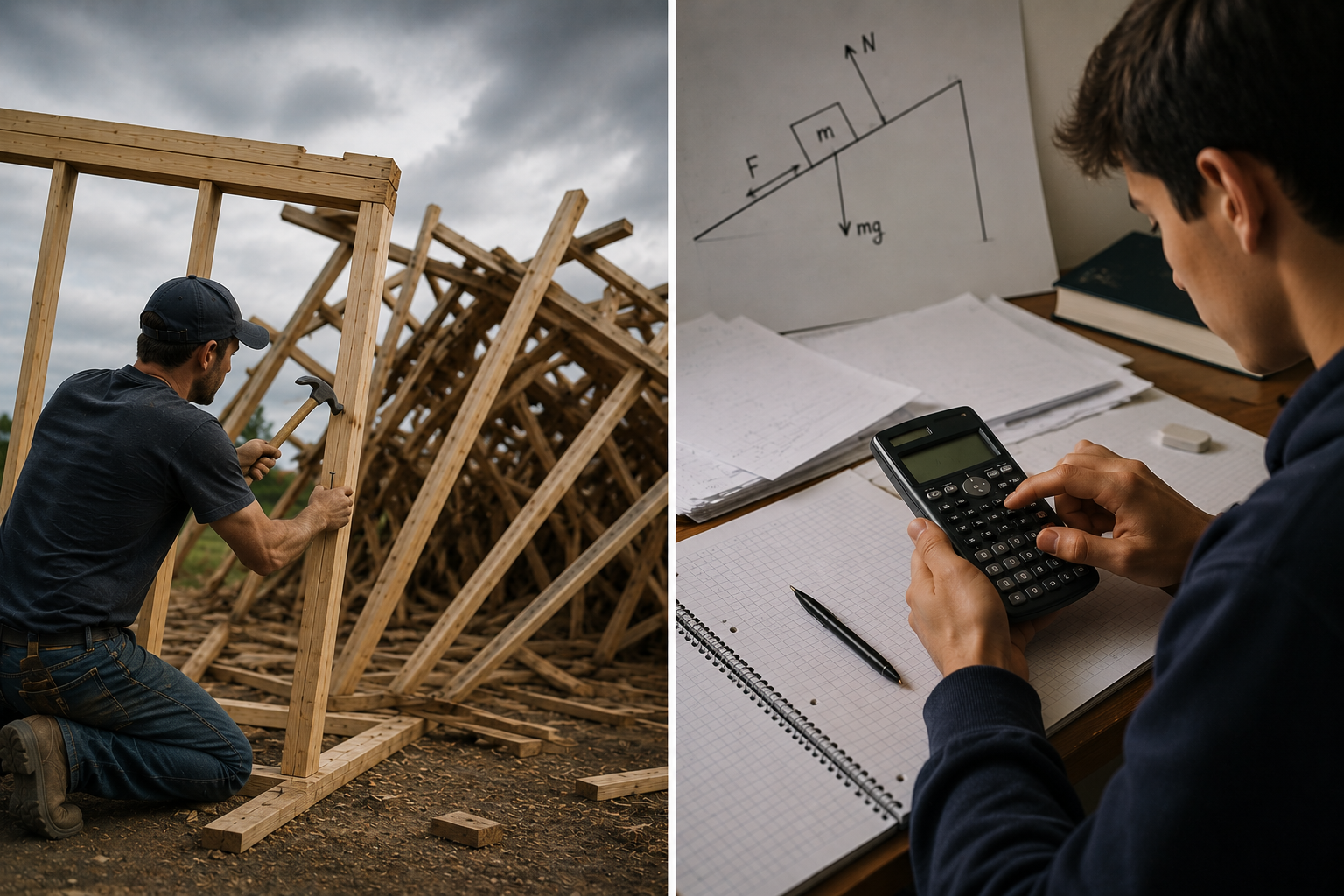
Students often confuse calculating with solving. But that is like thinking hammering nails is the same thing as building a house.
Hammering nails matters. It is part of building. But building also requires a plan, measurements, structure, alignment, order, and purpose. If you start hammering nails without understanding the structure first, you may end up with something that looks busy, but it is not a house.
Most people understand that difference when it comes to building a house. But it is not always obvious when it comes to solving a physics problem.
That is where many physics solutions fall apart.
In physics, calculations matter. But calculations cannot tell you whether students understood the situation, used the correct units, chose the right principle, or preserved the physical meaning of the problem.
I think we need to start teaching students to see the structure they are building, so they understand that random calculations will not create a solid solution.
When students calculate too early, the calculator does not create the mistake.
It just helps them reach the mistake faster.
This is one of the reasons I am developing the Gateway Physics Readiness Pilot: to help colleges identify these hidden performance gaps before students fall behind.
If you teach, coordinate, or support gateway physics courses, I would be glad to connect and compare what you are seeing with your students.
In gateway physics courses, many students believe that success depends mainly on finding the right equation. But the equation is only one part of the solution. Before students calculate, they need to identify what the problem is asking, what physical principle applies, what quantities are known, what units are involved, and what the answer should mean.
When that structure is missing, the work can look busy without being correct. A student may substitute numbers accurately and still solve the wrong problem. That is why physics problem solving has to be trained as a process, not just checked as a final answer.
This matters because these mistakes are often invisible until a quiz or exam exposes them. By then, the student may think the problem is intelligence, effort, or math ability. But often the real issue is that they were never trained to slow down before calculating.

0 Comments