Physics Sensei questions & answers
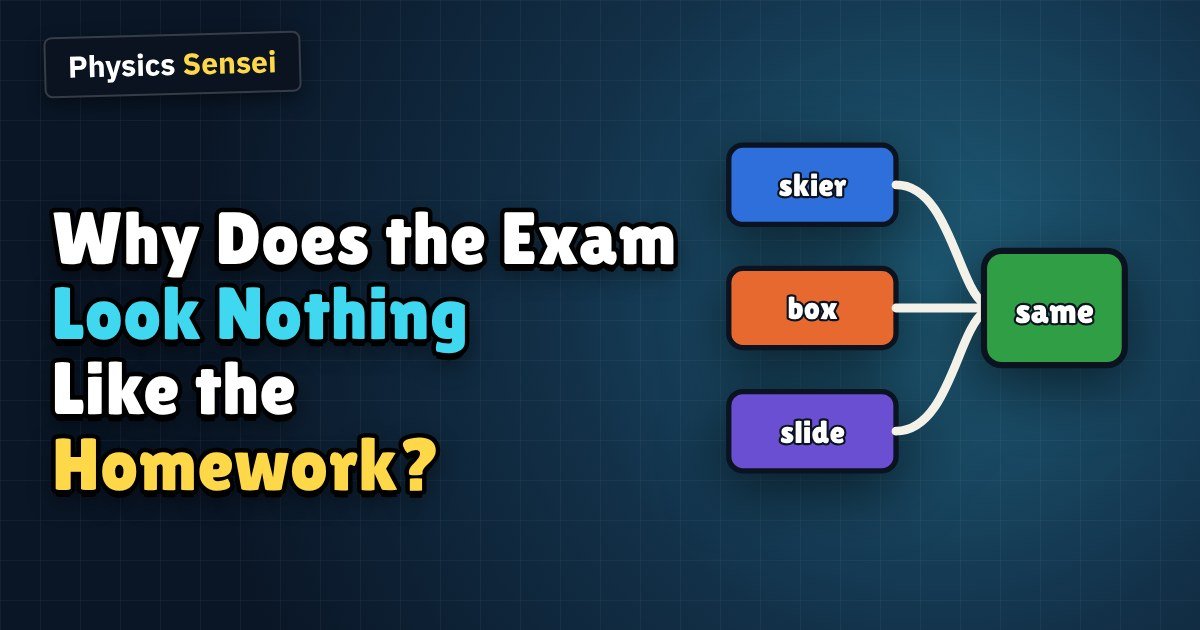
Why Can I Do Physics Homework but Fail Physics Exams?
Your online homework score is in the 90s. You can get every problem right, eventually. Then the physics exam comes back with a 55, covered in red marks.
Same topics. Same professor. Completely different result.
If you can do physics homework but fail physics exams, look at what each one actually checks. Online homework checks one thing. An exam checks something else.
What’s really going on
Most online physics homework only checks the number in the answer box. It doesn’t see your sketch, your setup, your equation, or your units. If the number matches, you get full credit, however you got there.
A physics exam is graded by a person reading your work. They look for a picture, the right big idea, the equation in symbols, units, and a final answer that makes sense. Many professors give partial credit for good work even when the final number is wrong, and little credit for a bare number.
So homework trains you to produce a number. The exam grades whether you can write a solution.
Why it gets worse
When only the number counts, it’s easy to skip the parts that don’t get checked: the sketch, the list, the units. Weeks of homework build the habit of solving in your head and typing a number.
On the exam, that habit costs you twice. You make more mistakes without written steps, and you lose the partial credit those steps would have earned.
Why it’s hard to change
Writing out a full solution when the computer only wants a number feels like wasted effort. Nobody is checking it.
But you’re not writing it for the computer. You’re practicing for the person who will grade your exam.
The fix: write it like it’s graded
For a couple of problems in every homework set, write a full solution as if your professor will grade it.
Try this on two problems per homework set: write it like it’s graded
- Draw a picture and label it.
- Ask: What are they asking? What do I know? Write the list with symbols and units.
- Ask: What’s the big idea? Write it in words, then write the equation in symbols.
- Do the math, keeping units on every number. Box your answer.
- Ask: Does it make sense? Then grade yourself with the checklist below, out of 5.
Two written solutions per set is enough to build the habit. The rest of the homework can stay quick.
What changes
The first few full solutions take longer. Soon they feel natural, and you’ll notice you make fewer mistakes, because every step is on paper where you can check it.
On the exam, your work looks like what the grader is looking for. Even when a number goes wrong, the points for good work are still there.
Homework checks the number. Exams grade the work. Practice the work.
Practice problems built for this
On Physics Sensei, every problem is solved step by step with the same five questions: What are they asking? What do I know? What’s the big idea? Do the math. Does it make sense? That’s the shape of a full exam solution. Each one asks you to try it first, then gives you one more like it, with new numbers.
Your next step: on your next homework set, write two problems as full solutions and grade them with the checklist. Then compare one with the steps on Physics Sensei.
More questions about studying and grades? See them all here.
Raul, Physics Sensei