

Foundational Physics
Short Answer: Direction matters for velocity because velocity describes both how fast and which way an object moves, while speed describes only how fast. Two objects moving equally fast in opposite directions have the same speed but different velocities.
Sensei’s Warning
The sign of a velocity is not a sign of how fast something travels. A negative velocity can describe motion in the opposite direction, not slower motion.
Can Two Cars Have the Same Speed but Different Velocities?
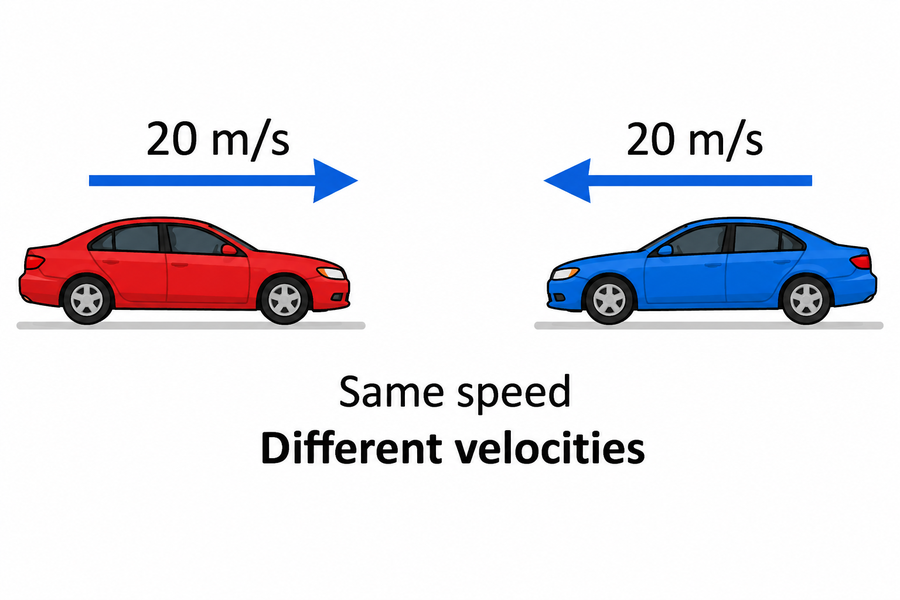
Imagine two cars traveling along a straight road. One moves east at 20 meters per second. The other moves west at 20 meters per second.
Both speedometers display the same speed: 20 m/s.
But the cars are not moving in the same direction. Their velocities are different, because velocity includes direction.
To describe their motion completely, saying only “20 m/s” is not enough. We also need “east” or “west.”
What Does Speed Tell You?
Speed tells you how much distance an object travels per unit time, without specifying direction.
The cars cover the same amount of distance each second, so they have the same speed—even as they head in opposite directions.
What Extra Information Does Velocity Give?
Velocity describes motion with direction. For straight-line motion, you can choose east as the positive direction and west as the negative direction.
With that convention, the eastbound car has velocity +20 m/s and the westbound car has velocity −20 m/s.
Those opposite signs indicate opposite directions. Neither car is moving faster than the other.
What Happens If a Car Reverses Direction?
Suppose a car is traveling east at 20 m/s. Later it travels west at 20 m/s.
Its speed can be the same before and after the reversal, but its velocity has changed from +20 m/s to −20 m/s, using east as positive.
The car must have accelerated at some point during the reversal, because its velocity changed. It cannot reverse direction instantaneously without a change in velocity.
Why Does This Difference Matter in Physics?
When calculating a change in position or acceleration, direction matters. Two cars with identical speeds can be moving apart, approaching each other, or traveling side by side, depending on their directions.
Speed alone cannot tell you which of those situations is happening.
The Key Idea to Remember
Speed tells you how fast; velocity tells you how fast and in which direction. Equal speeds do not imply equal velocities.
When This Breaks
This simple signed-number example assumes motion along one straight line. For motion in two or three dimensions, velocity requires a vector direction rather than only a plus or minus sign.
Continue with the Motion in One Dimension Unit Review
Choose the physics course that matches yours, then select the review depth that fits your time.
Foundational Physics
Algebra-Based Physics
Calculus-Based Physics
Reviewed by Physics Sensei
0 Comments