

Why Isn't Static Friction Always Equal to μₛN?
If you learned the formula
fs = μsN
it is easy to think that static friction must always have that value.
But that is not what the formula means.
μsN is the maximum possible static friction. The actual static-friction force can be anything from zero up to that maximum.
Static friction provides only as much force as is needed to keep two surfaces from sliding relative to each other.
Think of static friction as an adjustable force
Imagine a box sitting on a rough horizontal floor.
You push the box gently with a force of 10 N, but the box does not move.
If there are no other horizontal forces, what keeps it at rest?
Static friction.
To keep the box from accelerating, the floor must exert 10 N of static friction in the opposite direction.
So the static-friction force is 10 N.
Now increase your push to 20 N.
If the box still does not move, static friction increases to 20 N.
Push with 30 N, and static friction may increase to 30 N.
It does not immediately jump to its maximum value.
That is the key idea:
Static friction adjusts to what is needed.
So what does μₛN actually tell you?
The coefficient of static friction, μs, together with the normal force, N, tells you the largest static-friction force the contact can provide.
The correct relationship is
|fs| ≤ μsN
not
fs = μsN
for every static-friction situation.
Equality applies only when the surfaces are right at the threshold of slipping.
That condition is often called impending motion or impending slip.
A simple numerical example
Suppose a 10 kg box rests on a horizontal floor.
If there are no other vertical forces, the normal force is about 98 N.
Let the coefficient of static friction be
μs = 0.40
Then the maximum possible static friction is
fs,max = μsN = (0.40)(98 N) = 39.2 N
Does that mean the friction force is always 39.2 N?
No.
If you push horizontally with only 20 N and the box remains at rest, the actual static friction is 20 N in the opposite direction.
The contact could provide as much as 39.2 N, but it does not need to.
If you gradually increase your push, the static-friction force increases with it:
20 N push → 20 N static friction
30 N push → 30 N static friction
39.2 N push → 39.2 N static friction
At about 39.2 N, the contact has reached its static-friction limit.
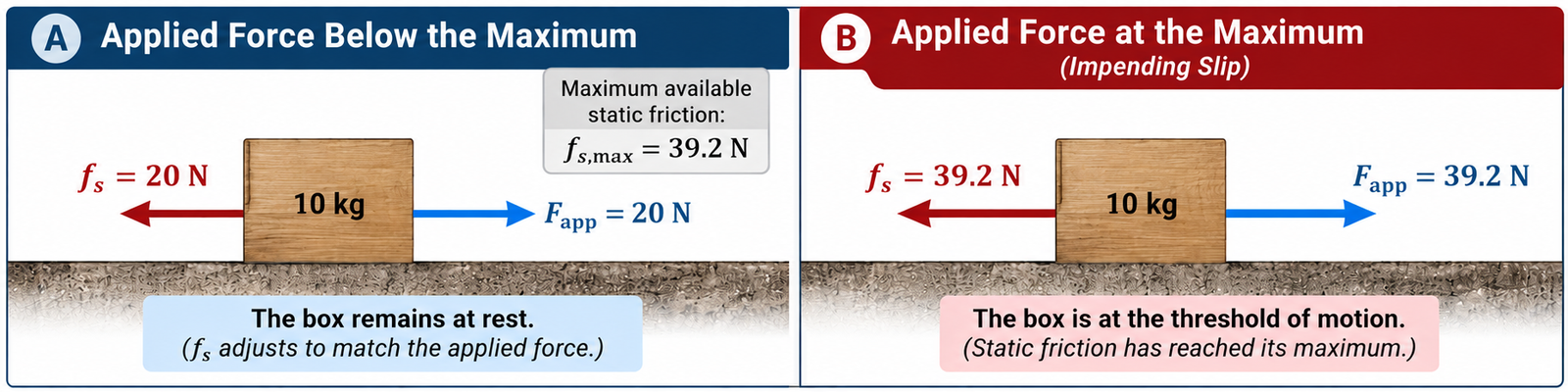
If the required friction becomes larger than the available maximum, static friction can no longer keep the surfaces from slipping.
The box begins to slide, and the situation changes to kinetic friction.
Why this formula causes so much confusion
Many physics formulas give you the actual value of a quantity.
For example, near Earth’s surface, the magnitude of an object’s weight is given by mg.
Static friction works differently.
The expression μsN gives you a limit.
That makes static friction more like a capacity than a fixed force.
A surface might be capable of providing 39.2 N of static friction, but if only 12 N is needed to prevent slipping, then the actual static friction is 12 N.
And if nothing is trying to make the surfaces slide relative to each other, the static-friction force can even be zero.
The question to ask before using μₛN
When you see a static-friction problem, do not automatically begin with
fs = μsN
Instead, ask:
Is the object actually on the verge of slipping?
If the answer is yes, then static friction has reached its limiting value, so
|fs| = μsN
is appropriate.
If the answer is no, use the other forces and Newton’s laws to determine how much static friction is actually required.
Then check that the required value satisfies
|fs| ≤ μsN
That small change in thinking prevents one of the most common mistakes in friction problems.
The takeaway
Static friction is not automatically equal to μsN.
It adjusts to whatever value is needed to prevent slipping, as long as that value stays within the limit
|fs| ≤ μsN
Only at impending slip does its magnitude reach
μsN.
Keep exploring: Friction, Inclines, and Connected Objects
If you want to review friction more deeply—including static versus kinetic friction, normal forces, inclines, and connected objects—choose the Physics Sensei review that matches your course. Then choose how much review you need.
Foundational Physics
- Quick Review — a fast refresher
- Focused Review — more explanation and examples
- Full Review — the most complete review
Algebra-Based Physics
- Quick Review — a fast refresher
- Focused Review — more explanation and examples
- Full Review — the most complete review
Calculus-Based Physics
- Quick Review — a fast refresher
- Focused Review — more explanation and examples
- Full Review — the most complete review

0 Comments