
The Water Park Effect: Why Physics Students Lose Points Before They Start Calculating
Many physics students lose points on tests because of the Water Park Effect.
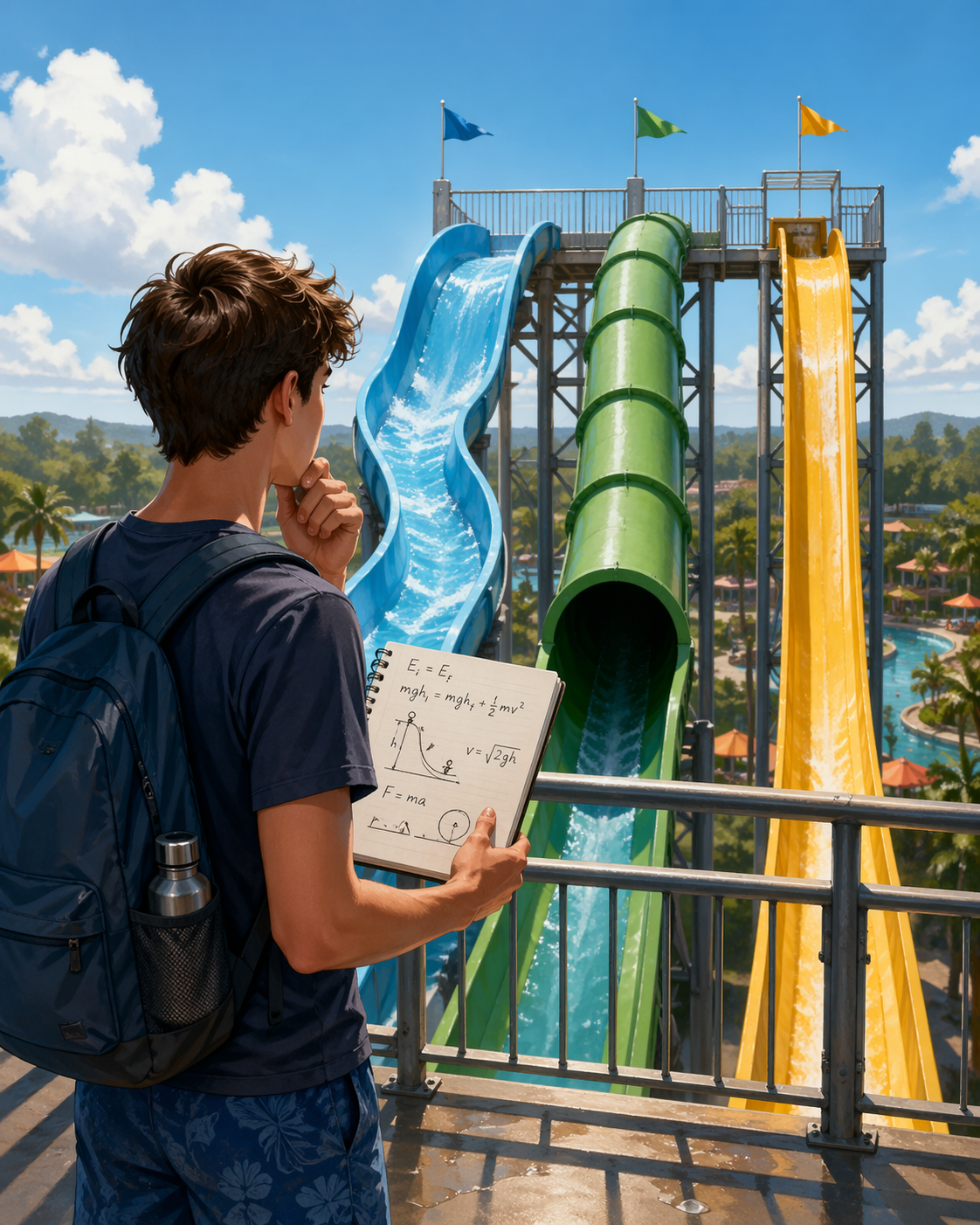
At a water park, when you are standing at the top, you may have three slides in front of you.
The open slide. The closed tunnel slide. The steep slide.
As long as you are still standing there, you have choices.
You can pause. You can look. You can compare. You can decide which slide makes sense.
But once you push off, momentum takes over.
You cannot stop halfway down and say, “Actually, I think I picked the wrong slide.” You find out at the bottom.
That is what happens to many students in physics.
They read the problem quickly. They skim for numbers. They search for a formula. They start plugging things in. They rush to do calculations.
And now they are sliding.
At that point, they are no longer choosing the approach. They are executing it.
The problem is that the most important decision was made too fast.
What is actually happening here? What principle applies? What am I solving for? Does this approach make sense?
In physics, the pause before the math matters.
That is where students should choose the right path, before momentum takes over, not after that.
This is one of the hidden readiness gaps the Gateway Physics Readiness Pilot is designed to help students catch early, before the semester starts and before students begin losing points they could have protected with better preparation.
If you work with students entering gateway physics courses and want to see how the pilot is designed, I invite you to take a look here.
Learn more about the Gateway Physics Readiness Pilot

0 Comments