

Foundational Physics
Short Answer: An object moving in a circle already has tangential velocity, and its inward acceleration continuously changes the direction of that velocity rather than making it travel straight toward the center.
Sensei’s Warning
Acceleration tells you how velocity changes, not necessarily which direction an object is moving. An object can accelerate toward the center while its instantaneous velocity points along the circular path.
How Can an Object Accelerate Inward Without Moving Straight Inward?
Imagine a ball attached to a string, moving around in a circle.
The string pulls the ball toward the center, yet the ball keeps traveling around the circle.
Why doesn't it simply move toward your hand?
Because the ball is already moving sideways relative to the inward pull.
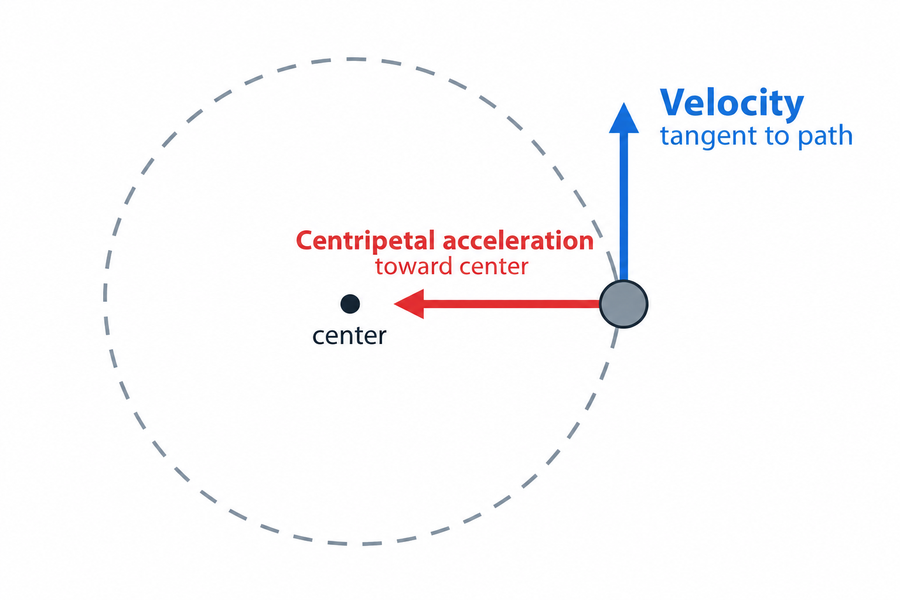
At each instant, its velocity points tangent to the circular path.
The inward acceleration changes that velocity a little at a time, continuously redirecting the ball.
The result is a curved path rather than a straight path toward the center.
What Does the Ball's Velocity Tell Us?
Velocity describes how fast something moves and in which direction.
For a ball moving in a circle, the instantaneous velocity always points along the tangent to the path.
That means the ball is not moving directly toward the center at that instant.
Meanwhile, the string pulls inward and produces an acceleration toward the center.
These two directions are perpendicular during uniform circular motion.
The ball keeps moving along the path while the inward acceleration continually changes where its velocity points.
Why Does the Path Curve?
Imagine watching the ball move over a very short interval.
Without an inward force, the ball would continue along a straight tangent, assuming no other forces acted.
With the inward force, its velocity changes slightly toward the center.
A moment later, the ball has a new velocity direction, and the inward acceleration changes that direction again.
This process repeats continuously.
Instead of following the original straight-line path, the ball follows a circle.
The inward acceleration keeps bending the motion without eliminating the tangential velocity.
Is the Ball Ever Moving Toward the Center?
Its velocity is not directed toward the center during ideal uniform circular motion.
The ball's position changes around the circle, but its distance from the center remains constant.
Although its path curves inward relative to the straight tangent it would otherwise follow, it does not get progressively closer to the center.
This distinction is essential:
An inward acceleration is not the same thing as an inward velocity.
What Happens If the String Breaks?
The inward force supplied by the string disappears.
At that instant, the ball still has its tangential velocity.
Without another force changing its motion, it would continue along a straight tangent rather than continuing around the circle or moving directly away from its center.
In a real demonstration, gravity may then curve the ball's path downward.
The important point is that removing the inward force does not make the ball suddenly travel along a radial line.
The Key Idea to Remember
Centripetal acceleration continually turns the velocity toward the center, allowing an object with tangential velocity to follow a circular path instead of moving straight inward.
When This Breaks
This explanation assumes circular motion with purely inward acceleration. If the object's velocity gains an inward or outward component, its distance from the center can change, and the path may no longer be circular.
Continue with the Uniform Circular Motion Unit Review
Choose the physics course that matches yours, then select the review depth that fits your time.
Foundational Physics
Algebra-Based Physics
Calculus-Based Physics
Reviewed by Physics Sensei


0 Comments