

Foundational Physics
Short Answer: Yes. An object can keep moving with constant velocity while its acceleration is zero, because acceleration measures a change in velocity, not motion itself.
Sensei’s Warning
Zero acceleration does not mean zero velocity. It means velocity is not changing in magnitude or direction.
How Can Something Move Without Accelerating?
Imagine a car moving along a straight, level road at a steady 50 mph.
The car keeps traveling forward. Its speed stays the same, and its direction stays the same.
Is the car accelerating?
No.
Because neither the speed nor the direction changes, the car’s velocity is constant. Its acceleration is zero even though it is still moving.
What Does Zero Acceleration Actually Mean?
Acceleration describes how velocity changes over time.
Velocity includes both speed and direction. If neither changes, acceleration is zero.
That does not require the object to stop. The car could travel a long distance while its acceleration remains zero.
Does the Car Need a Force to Keep Moving?
In everyday driving, the car experiences resistive forces such as air resistance and rolling resistance. The tires must supply a forward force to balance those resistive forces if the car maintains a constant velocity.
On a level road, the upward normal force also balances the downward weight.
When all the forces balance, the net force is zero. Newton’s Second Law tells us that the acceleration is then zero.
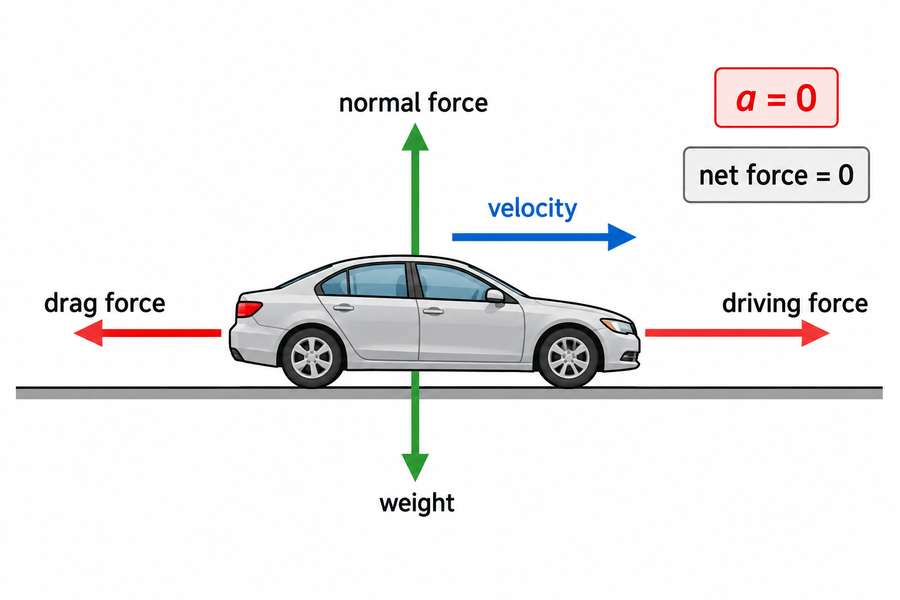
The forces don’t need to disappear; they need to have a zero net result.
What Would Happen Without Any Forces?
In an ideal situation with no net force, an object already in motion keeps moving in a straight line at constant speed.
This is Newton’s First Law.
For example, a spacecraft far from significant external influences can continue moving without a continuous push in its direction of motion.
That is different from a car on a real road, where forces must balance to overcome resistance.
How Is This Different From Zero Velocity?
An object can have zero velocity at one instant and still be accelerating—for example, a ball at the highest point of a vertical throw.
But when acceleration is zero, velocity stays constant. That constant velocity may be zero, or it may be nonzero.
Zero acceleration tells you about changes in motion, not whether motion exists.
The Key Idea to Remember
An object can move at a constant nonzero velocity while its acceleration is zero. Motion does not require a net force; changing velocity does.
When This Breaks
The conclusion no longer holds if the object’s speed or direction changes. Turning a corner, speeding up, or slowing down means velocity changes and acceleration is nonzero.
Continue with the Motion in One Dimension Unit Review
Choose the physics course that matches yours, then select the review depth that fits your time.
Foundational Physics
Algebra-Based Physics
Calculus-Based Physics
Reviewed by Physics Sensei

0 Comments