

Foundational Physics
Short Answer: Acceleration is measured in meters per second squared (m/s²) because it tells us how much velocity, measured in meters per second, changes each second.
Sensei’s Warning
The second in m/s² does not mean the object travels for two seconds. It means the change in velocity is measured per second.
Why Are There Two Seconds in the Units?
Imagine a car driving in a straight line. You measure how fast it moves in meters per second (m/s).
Now suppose the car’s velocity increases by 2 m/s during each second.
After one second, its velocity is 2 m/s greater. After another second, its velocity increases by another 2 m/s.
That repeated change is its acceleration.
We describe it as 2 meters per second per second, written 2 m/s².
What Does 2 m/s² Actually Tell You?
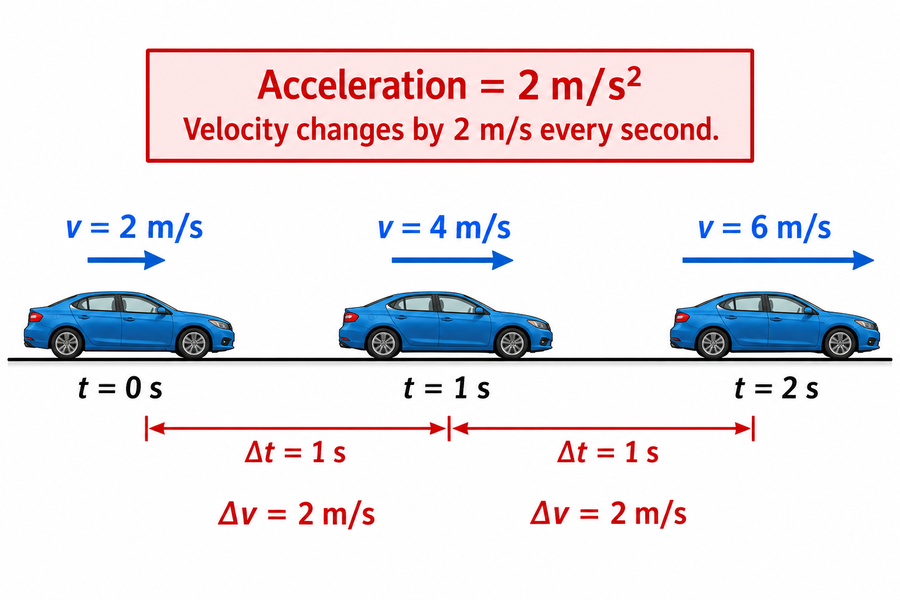
Suppose the car starts at 2 m/s and accelerates steadily in the same direction.
- At 0 seconds, its velocity is 2 m/s.
- At 1 second, its velocity is 4 m/s.
- At 2 seconds, its velocity is 6 m/s.
The velocity gains 2 m/s in every one-second interval. That is what the acceleration value tells you.
Why Not Just Use m/s?
Meters per second tells us velocity: how quickly position changes.
Acceleration tells us something different: how quickly velocity changes.
Because velocity is already measured in m/s, we need to divide its change by time in seconds. That gives (m/s)/s, which is the same as m/s².
That extra second is what distinguishes the rate of change of velocity from velocity itself.
Does m/s² Always Mean Speeding Up?
No. Acceleration is a change in velocity, and velocity includes direction.
An object can have acceleration while slowing down or turning, not just while speeding up.
The unit m/s² is used in all of these cases because it measures the rate at which velocity changes.
The Key Idea to Remember
Acceleration in m/s² tells you how many meters per second the velocity changes in each second.
When This Breaks
The simple equal-increments example assumes constant acceleration along a straight line. If acceleration changes with time or direction, the velocity change need not be the same in every one-second interval, but the units remain m/s².
Continue with the Motion in One Dimension Unit Review
Choose your course and the review depth that fits your time.
Foundational Physics
Algebra-Based Physics
Calculus-Based Physics
Reviewed by Physics Sensei

0 Comments