

Foundational Physics
Short Answer: Yes. Average velocity can be zero while average speed is positive because average velocity depends on displacement, while average speed depends on total distance traveled.
Sensei’s Warning
Returning to your starting position does not mean you traveled zero distance. It means your total displacement is zero. Distance and displacement are not interchangeable.
How Can You Move and Still Have Zero Average Velocity?
Imagine walking along a straight path in a park.
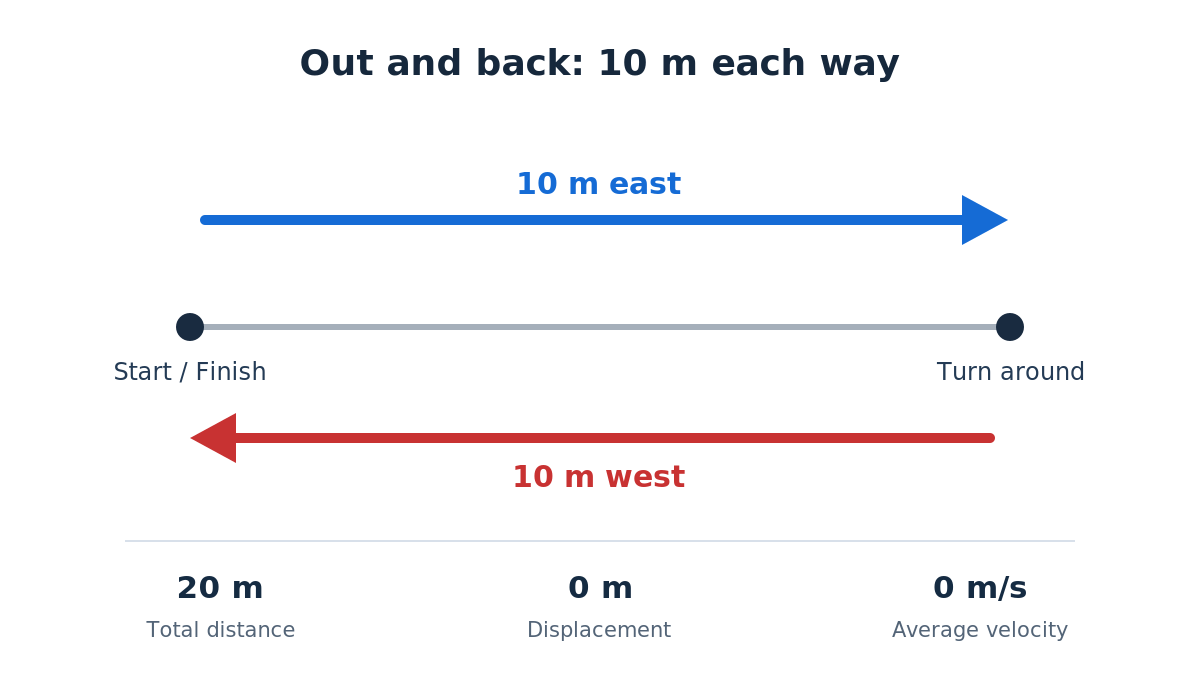
You walk 10 meters east, turn around, and walk 10 meters west until you arrive at your starting point.
You have definitely moved. You have also traveled a measurable distance.
But where are you compared with where you started?
Exactly where you began.
That is why this trip has a special result:
Your average velocity is zero, even though your average speed is not.
What Is the Difference Between Distance and Displacement?
Distance tells you how much ground you covered along your journey.
Displacement tells you the change in your position from where you started to where you finished.
For our walk:
- Outward trip: 10 meters east.
- Return trip: 10 meters west.
- Total distance: 20 meters.
- Total displacement: 0 meters.
Both parts of the walk contribute to the distance traveled, but the opposite displacements cancel.
Why Is Average Velocity Zero?
Average velocity is calculated using displacement divided by elapsed time:
Average velocity = displacement ÷ elapsed time.
Since your displacement is zero, your average velocity is zero for any positive trip duration.
It does not matter whether the walk took 10 seconds, 20 seconds, or one minute. If you return to your starting position, the average velocity for the complete trip is zero.
Why Isn't Average Speed Also Zero?
Average speed uses total distance rather than displacement:
Average speed = total distance ÷ elapsed time.
Suppose your 20-meter round trip takes 20 seconds.
Your average speed is 20 m ÷ 20 s = 1 m/s.
But your average velocity is 0 m ÷ 20 s = 0 m/s.
The two answers are different because they describe different aspects of the same trip.
Were You Ever Moving If Your Average Velocity Was Zero?
Absolutely.
During the outward trip, your velocity pointed east. During the return trip, it pointed west.
Your average velocity of zero does not mean your velocity was zero throughout the trip.
It only describes your overall displacement divided by the total elapsed time.
This is one of the reasons an average quantity cannot always tell you what happened at every instant.
Does This Work Only for Walking?
No. The same principle applies to a runner completing a lap around a track, a car leaving home and returning, or any object that finishes where it started.
For a complete round trip, displacement is zero. If the object traveled a nonzero distance in a finite positive time, its average speed is positive.
The Key Idea to Remember
Average speed measures total distance per unit time. Average velocity measures displacement per unit time.
You can travel a considerable distance and still have zero average velocity if you finish exactly where you started.
When This Breaks
The zero-average-velocity result requires the final position to equal the starting position. If you finish somewhere else, your displacement is nonzero, so your average velocity over a finite time interval is also nonzero.
Continue with the Motion in One Dimension Unit Review
Choose the physics course that matches yours, then select the review depth that fits your time.
Foundational Physics
Algebra-Based Physics
Calculus-Based Physics
Reviewed by Physics Sensei


0 Comments