Physics Sensei questions & answers
How Do I Solve Physics Problems with Only Letters and No Numbers?
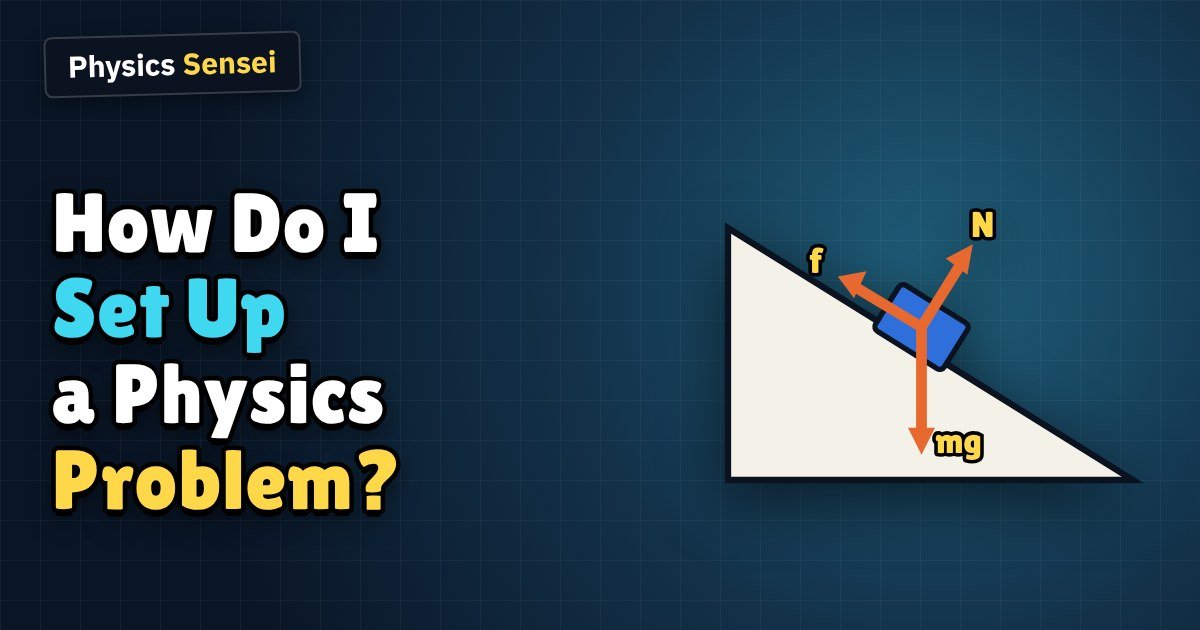
The problem says: a block of mass m slides down a smooth ramp at angle θ. Find its acceleration in terms of g and θ. No numbers anywhere.
Your mind goes blank. Without numbers, you don’t know where to start, and you can’t even tell if your answer is right.
Problems with only letters and no numbers feel like a different kind of physics. They’re not. You solve them the same way, and a simple trick makes them feel normal.
What’s really going on
Letters are just numbers you haven’t been told yet. Every step you’d do with numbers works the same with letters: draw it, list what you know, pick the big idea, write the equation, solve for the unknown.
The only difference is the answer. Instead of a number, you get a recipe. Plug in any mass and any angle, and it tells you the acceleration. That’s why professors like these problems: a recipe shows you understand the physics, not just the arithmetic.
Why avoiding letters makes it worse
When letters show up, many students try to invent numbers and stop there, or wait for the professor to give them. That avoids the skill instead of building it.
And these problems tend to show up on exams, because they test understanding. Avoiding them on homework means meeting them for the first time on the test.
Why it’s hard to change
With numbers, you can see the answer taking shape. With letters, the page can look like a pile of symbols, and it’s hard to know if you’re on the right track.
That’s why you need a way to check a letter answer. It turns out letter answers are actually easier to check than number answers.
The fix: three passes
Use made-up numbers to find the path, follow the same path with letters, then check the recipe.
Try this on your next letters-only problem: three passes
- Pass 1: make up easy numbers for every letter, like m = 2 kg and θ = 30°. Solve it the usual way. Ask: What are they asking? What do I know? What’s the big idea?
- Pass 2: do the exact same steps again, but keep the letters. Every place you used 2 kg, write m instead. Don’t plug in anything.
- Pass 3, check the units: does your answer have the right units? An acceleration should come out in m/s².
- Check an easy case: what if the angle is 0, a flat floor? The block shouldn’t move, so your answer should give zero. What if the angle is 90°? It should fall freely, at g.
- Plug your made-up numbers into your letter answer. It should match Pass 1.
What changes
Pass 1 might feel like cheating at first. It’s not. It’s how you find the path. After a few problems, you won’t need it, and the letters will feel like numbers you just haven’t been told.
The checks become a habit you’ll use on every problem. Units and easy cases catch mistakes that numbers hide.
Letters are numbers you haven’t been told yet.
Practice problems built for this
On Physics Sensei, every problem is solved step by step with the same five questions, and the last one, “Does it make sense?”, is where units and easy cases come in. Each problem asks you to try it first, then gives you one more like it, with new numbers. You find out right away exactly where you slipped.
Your next step: on your next letters-only problem, use the three passes. Then try a problem on Physics Sensei and run the easy-case check on your answer.
More questions about studying and grades? See them all here.
Raul, Physics Sensei