Physics Sensei questions & answers
Why Did I Forget How to Solve Problems I Did Last Week?
Last Tuesday, you solved a problem about a block on a ramp. You understood it. You got it right. Today, a problem just like it shows up, and you can’t remember how to start.
It’s frustrating. You did the work. Where did it go?
If you forgot how to solve problems you did just last week, your memory isn’t broken. You remembered the wrong part of the problem.
What’s really going on
When you solve a problem, you can remember two different things. You can remember the steps: first this equation, then plug in that, then solve. Or you can remember the reasons: this is a motion problem with constant acceleration, and no final speed is given, so I use the equation without it.
Steps fade fast. They’re a long chain of small details, and a week later, a few links are missing. Reasons last much longer, because they’re short and they connect to the big ideas you use again and again.
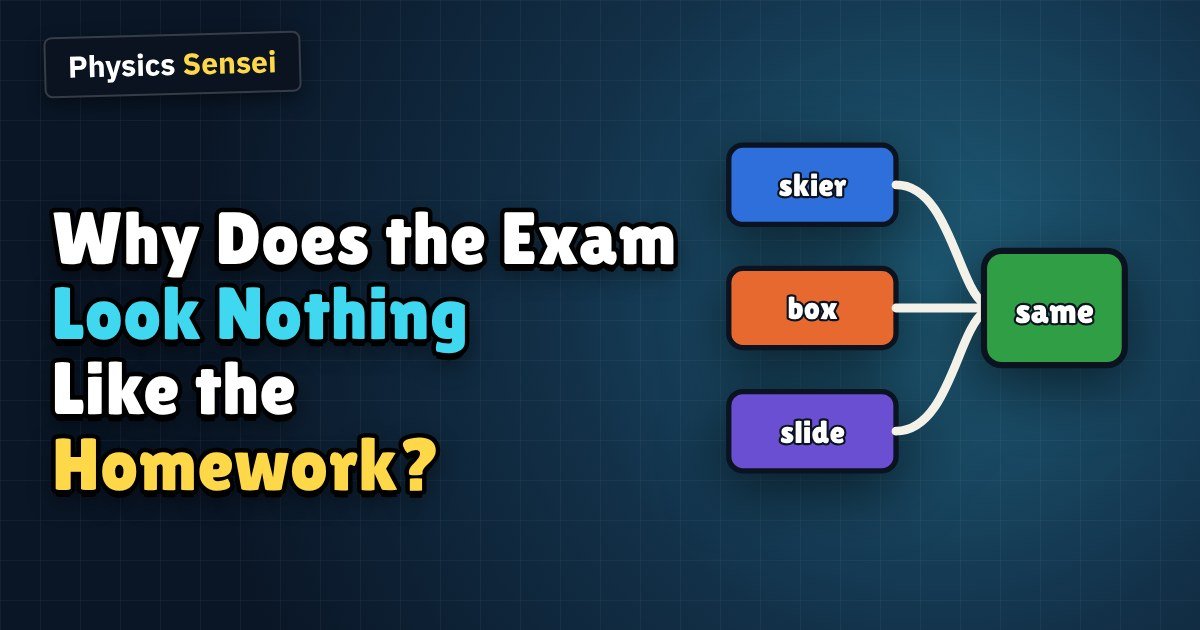
Most students remember the steps. That’s why the problem disappears.
Why looking at the old solution makes it worse
When you forget, the natural fix is to look at the old solution and follow it again. It comes back right away, which feels reassuring.
But you’re refreshing the steps, not the reasons. So a week later, the steps fade again, and you’re back where you started.
Why it’s hard to change
Writing down reasons feels unnecessary while you’re solving. The reasons seem obvious in the moment. You don’t feel the need to write them until a week later, when they’re gone.
So the habit has to start while the problem is still fresh.
The fix: write the why
After you solve a problem, spend one more minute writing down why each key step works. Then test yourself a few days later using only the reasons.
Try this on your homework this week: write the why
- Solve the problem as usual. Ask: What are they asking? What do I know? What’s the big idea?
- Under your solution, write one line for the big idea, like “Motion with constant acceleration, because the ramp is smooth and gravity stays the same.”
- Next to each key step, write a short why, like “starts from rest, so v₀ = 0.”
- Three days later, cover the solution. Read only the why lines, and solve the problem again on a blank page.
- If you get stuck, add the missing reason to your why lines. That’s the part you hadn’t really learned.
What changes
Writing the why takes about a minute per problem. In return, problems stop disappearing after a week.
And something else happens: the reasons repeat. “Starts from rest, so v₀ = 0” shows up in problem after problem. Soon you’re not remembering hundreds of steps. You’re remembering a handful of reasons.
Steps fade. Reasons stay. Write down the why.
Practice problems built for this
On Physics Sensei, every problem is solved step by step, and each step explains why it works, not just what to do. Each one asks you to try it first, then gives you one more like it, with new numbers, so you can test whether the reasons stuck.
Your next step: write the why on three homework problems this week. Three days later, solve one again from the why lines only.
More questions about studying and grades? See them all here.
Raul, Physics Sensei