

Can Static Friction Be Zero Even When Two Surfaces Touch?
Level: Foundational
Short Answer
Yes. Two surfaces can be touching and the static friction between them can still be zero. Static friction appears only when it is needed to prevent the surfaces from sliding relative to each other.
Touching does not automatically mean friction
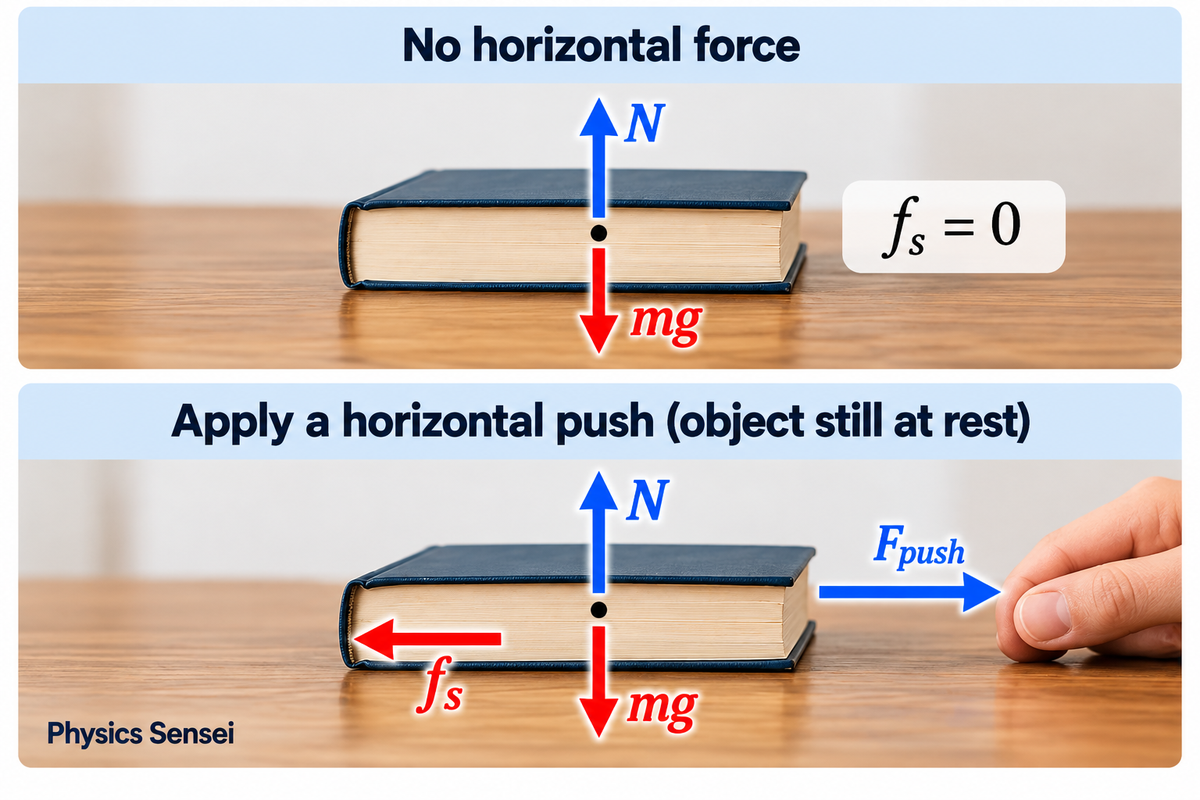
Imagine a book sitting quietly on a horizontal table.
The book and table are touching.
The table pushes upward on the book with a normal force, and gravity pulls downward on the book.
But suppose nothing is pushing or pulling the book horizontally.
Does the table need to exert a horizontal friction force to keep the book from sliding?
No.
There is no tendency for the book to slide across the table, so there is nothing for static friction to oppose.
In this situation, fs = 0.
The surfaces are in contact. They may even be rough. But the actual friction force is still zero.
Think of static friction as a force that responds
Static friction is different from a force such as weight.
If an object has mass near Earth's surface, gravity acts on it whether or not another horizontal force is present.
Static friction does not work that way.
It responds to what is happening at the contact surface.
Suppose you now gently push the book to the right.
If the book remains at rest, it has a tendency to slide to the right relative to the table.
Static friction responds by acting to the left.
Push with 2 N, and if the book remains at rest, static friction may be 2 N in the opposite direction.
Stop pushing.
The tendency to slide disappears.
The static friction can return to zero.
Static friction is not automatically present because surfaces touch. It supplies the force needed to prevent relative slipping.
Rough surfaces can have zero friction
This sometimes seems strange because we associate rough surfaces with friction.
But roughness tells you about the friction that can be available. It does not tell you that a nonzero friction force must be acting right now.
Imagine a heavy wooden box sitting on a rough floor.
The floor might be capable of exerting a substantial static-friction force.
But if no other force is trying to make the box slide along the floor, the required static friction may be zero.
The ability to provide friction and the actual friction being provided are not the same thing.
Static friction adjusts to what is needed
In the standard introductory model, static friction satisfies
|fs| ≤ μsN
This tells us that static friction can range from zero up to a maximum value.
It does not tell us that static friction is always equal to μsN.
For example, if 5 N of friction is needed to prevent slipping, static friction can be 5 N.
If 12 N is needed, it can be 12 N.
If no friction is needed, it can be fs = 0.
Only when the contact reaches the threshold of slipping does the magnitude of static friction reach its maximum value.
Ask what would happen without friction
A useful way to decide whether static friction is acting is to ask:
If there were no friction, would these two surfaces tend to slide relative to each other?
If the answer is no, the required static friction may be zero.
If the answer is yes, static friction may be needed to prevent that relative motion.
This also helps determine the direction of friction. Instead of automatically drawing a friction arrow, first identify the direction in which the surfaces would tend to slip relative to one another.
Then static friction acts, when needed, to oppose that tendency.
Contact is necessary—but not sufficient
For ordinary contact friction, the surfaces must be touching.
But contact by itself does not determine the friction force.
A book resting on a table can have:
- a downward gravitational force,
- an upward normal force,
- and zero horizontal static friction.
Nothing is missing from the free-body diagram.
There simply is no horizontal friction force required in that situation.
The takeaway
Static friction can absolutely be zero even when two surfaces are touching.
Contact allows a friction force to exist, but static friction appears only to the extent needed to prevent relative slipping.
So when drawing a free-body diagram, never add friction automatically just because you see a contact surface.
Ask first:
What would the surfaces tend to do relative to each other if friction were absent?
If there is no tendency to slip, the correct static-friction force may be zero.
When This Breaks: This reasoning uses the standard introductory dry-friction model. In more complicated real contacts—such as adhesive, deformable, rolling, or other non-ideal interactions—the simple static-friction model may not describe every contact force.
Want to go deeper?
Continue with Friction, Inclines, and Connected Objects. Choose the Physics Sensei review that matches your course, then choose how much review you need.
Foundational Physics
- Quick Review — a fast refresher
- Focused Review — more explanation and examples
- Full Review — the most complete review
Algebra-Based Physics
- Quick Review — a fast refresher
- Focused Review — more explanation and examples
- Full Review — the most complete review
Calculus-Based Physics
- Quick Review — a fast refresher
- Focused Review — more explanation and examples
- Full Review — the most complete review


0 Comments