

Foundational Physics
Short Answer: Friction points up an incline when a block would otherwise slide downhill, because friction acts against the slipping tendency along the surface.
Sensei’s Warning
Gravity pulls straight down, but friction acts along the incline. Never assume friction points downhill just because the surface slopes downward.
Why Does the Block Want to Slide Downhill?
Imagine placing a book on a rough, tilted board.
Gravity pulls the book straight down. But because the board is tilted, part of that pull tends to move the book down the surface.
If the board is not too steep, the book can remain at rest. What keeps it from sliding?
Static friction acts uphill, balancing the downhill pull along the board. The book doesn’t have to move for friction to act.
Which Forces Act on the Block?
For a block resting on a rough incline, with no rope or additional applied force, there are three forces to consider:
- Weight: Acts vertically downward.
- Normal force: Acts perpendicular to the inclined surface.
- Static friction: Acts uphill to prevent downhill slipping.
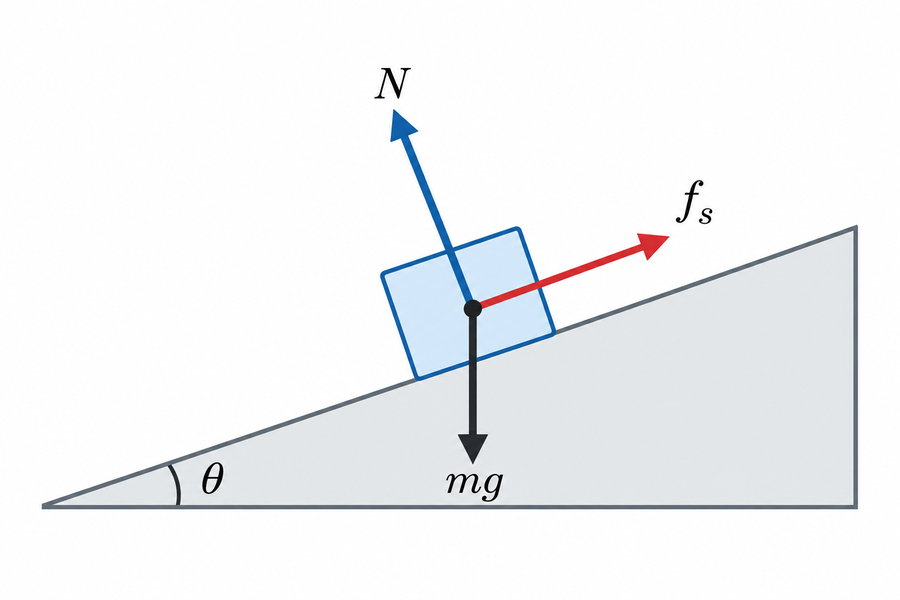
These forces can balance even though they point in different directions. Gravity’s pull along the slope is downhill, while friction can oppose it by acting uphill.
What Happens If the Incline Gets Steeper?
As you increase the angle of the board, gravity’s pull along the slope becomes stronger.
Static friction can increase to keep the block in place, but only up to a maximum.
If the downhill pull becomes too large, the block starts sliding. Once it slides, kinetic friction acts uphill against the downhill sliding motion.
So friction can point uphill whether the block remains at rest or slides downhill. The type of friction changes, but its direction in these examples does not.
Can Friction Ever Point Down the Incline?
Yes. Consider a block being pulled uphill by a rope.
If the rope pulls strongly enough that the block would otherwise start sliding uphill, static friction acts downhill.
This is still an inclined plane. What changes is the direction in which the block tends to slip.
The Key Idea
On an incline, gravity often creates a downhill slipping tendency. Friction can point uphill to oppose that tendency.
When This Breaks
The uphill-friction conclusion does not apply automatically when additional forces act on the block. An uphill pull can reverse the slipping tendency, causing static friction to point downhill instead.
For the general rule behind friction’s direction, see How Does Static Friction Know Which Direction to Point?
Continue with the Friction, Inclines, and Connected Objects Unit Review
Choose the physics course that matches yours, then select the review depth that fits your time.
Foundational Physics
Algebra-Based Physics
Calculus-Based Physics
Reviewed by Physics Sensei


0 Comments