Physics Sensei questions & answers
Why Am I Studying So Hard but Still Getting Bad Grades?
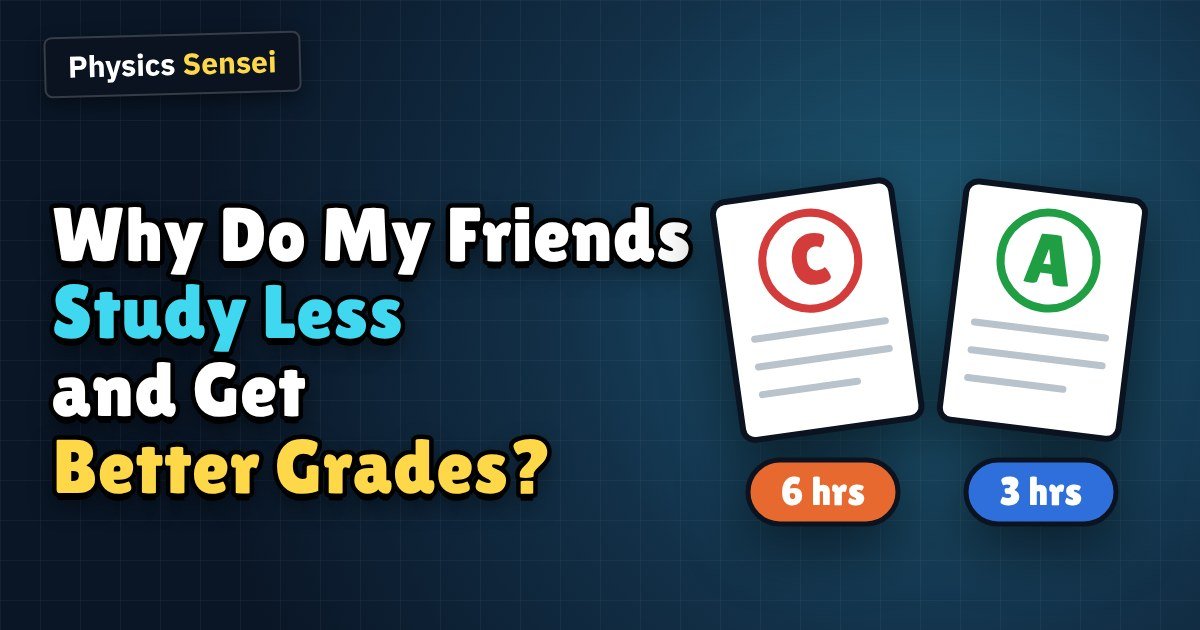
You go to every class. You do all the homework. You study for hours before the quiz. Then you get your score back, and it’s barely better than last time.
So you study even more for the next quiz. Twice as many hours. Your grade still doesn’t move. And a friend who studied the night before gets a better score than you.
That feels unfair. You might start to think you just aren’t good at this class. But you are. If you’re studying hard but still getting bad grades, the number of hours is not the problem. The problem is what you practice during those hours.
What’s really going on
When you study, you get better at what you do while you study. That’s it. So the big question isn’t how long you studied. It’s what you practiced.
Look at how a normal study session compares to the exam:
Every hour on the left makes you better at the left side. Study twice as long, and you get twice as good at studying with your notes open. But the exam checks the right side. And you haven’t practiced that yet.
That’s why more hours give you the same score. You keep doing the same kind of practice, so you keep getting the same kind of result.
Why studying longer can make it worse
When you follow a solution step by step, it feels like you know how to do it. Each hour with your notes open makes that feeling stronger. So you walk into the exam feeling ready. Then the score says you weren’t.
The only way out of this loop is to change how you practice. More hours just send you around the loop again.
Why it’s hard to change
The fix feels bad at first. When you try a problem on a blank page with no notes, it’s slow. You get stuck. You make mistakes. Reading your notes feels much nicer.
But that bad feeling is exactly how the exam feels. It’s much better to feel it at your desk, where mistakes don’t cost you points. If you skip it at home, you’ll feel it for the first time on exam day.
The fix: same hours, different practice
You don’t need more time. Keep the hours you already study. Just make part of that time feel like the exam. Start with the first 20 to 30 minutes each time you study.
Try this next time you study: the blank page
- Pick three problems you already did. They can be homework, an old quiz, or an example from class. Try to pick them from different chapters.
- Close your notes, your book, and the answers. Put your phone in another room. Give yourself about 10 minutes for each problem.
- On a blank page, answer the five questions in the picture below, in order.
- When time is up, check your work. Circle the first question where you got stuck.
- The next day, do one new problem like that one. Use a blank page again before you look at anything.
Stuck on “What do I know?” Practice finding the facts hiding in the problem. Stuck on “What’s the big idea?” Practice picking between forces, energy, and momentum. Either way, you now know what to work on. No more rereading everything.
What changes
The first few blank pages will feel slow. You’ll get stuck more than you want. That’s normal. That’s where you get better. After a week or two, starting a problem with nothing open won’t feel scary anymore. And the exam won’t feel like a different class.
Same hours. Different practice. Different score.
Practice problems built for this
On Physics Sensei, every problem is solved step by step with the same five questions. Each one asks you to try it first. Then it gives you one more like it, with new numbers. You find out right away exactly where you slipped.
Your next step: pick one topic from your next quiz. Do one problem on Physics Sensei, and use a blank page first.
Have another question about studying? See all questions & answers.
Raul, Physics Sensei