Foundational Physics
Short Answer: A battery uses stored chemical energy to maintain a voltage between its terminals. When a conducting circuit is closed, this helps establish an electric field that drives charges already present in the circuit and transfers energy to devices such as light bulbs. The battery does not create electric charge.
Sensei’s Warning
A battery is not a supply of brand-new electrons that must travel all the way from one terminal to a bulb before it can work. Charges already exist throughout the wires. The battery supplies energy and maintains a potential difference, not a net creation of electric charge.
Does a battery create electrons?
No. Metal wires already contain mobile electrons. In a simple closed circuit, charge moves through the wires and components without being created or used up. The battery’s chemical reactions move charge internally and help maintain a separation of charge between its terminals.
Charge is conserved: a working battery does not manufacture the electrons that carry current through the external circuit.
What does the battery actually provide?
A battery maintains an electric potential difference—usually called voltage—by converting stored chemical energy into electrical energy available to the circuit. Inside the battery, chemical processes move charges in ways that maintain the terminal voltage.
When you connect a complete conducting path, the resulting electric field in the circuit drives a current. Electrical energy is then transferred to the components along that path.
What does a 1.5-volt battery mean?
A potential difference of 1.5 volts corresponds to an electrical energy difference of 1.5 joules per coulomb of charge between the terminals.
1.5 V = 1.5 J/C
This does not mean the battery contains only 1.5 joules of energy, or that every electron gains exactly 1.5 joules. It describes energy per unit charge.
Why does a bulb light up when the circuit closes?
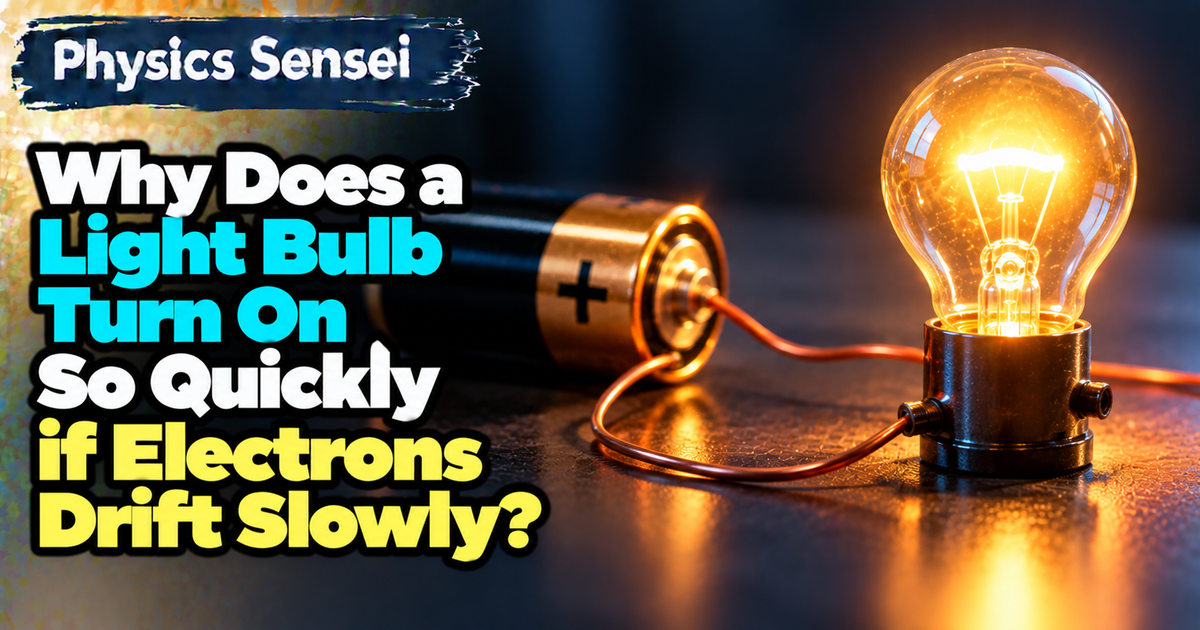
The wires and bulb already contain charges. Closing the conducting path establishes an electric field through the circuit, and charges begin to drift. Energy is transferred from the battery to the bulb, where it becomes light and thermal energy.
The individual electrons drift slowly in an ordinary metal wire; the electrical response spreads through the connected circuit much faster than that drift speed.
Does having a battery always mean current flows?
No. An open circuit can have a battery voltage but no sustained current through the gap. When a path is closed, the current depends on the voltage and the properties of the connected components.
A real battery also has limitations and its voltage can change under load, but those details are separate from the battery’s basic role as an energy source.
The takeaway
A battery moves energy through a circuit by maintaining a potential difference; it does not create the charge that carries that energy. The charges are already present in the conducting path.
When This Breaks
This simple description applies to ordinary electrochemical batteries and conventional circuits. Battery terminal voltage may change with state of charge and current, and real batteries have internal losses. Some materials conduct through ions rather than electrons.
The exact electric-field distribution and energy transport in a real circuit can be more complicated than the introductory picture. Voltage can exist even when the circuit is open; a complete conducting path is needed for sustained current.
Keep Exploring: Current, Resistance, and Ohm’s Law
Want to connect voltage, current, resistance, and energy transfer? Choose your Physics Sensei Unit Review for your course and available time.
Foundational Physics
Algebra-Based Physics
Calculus-Based Physics
Reviewed by Physics Sensei
Still stuck? Get unstuck. Choose the review that matches your course and the time you have.