Foundational Physics
Short Answer: A short circuit creates an unintended path with very low resistance, often bypassing the part of the circuit meant to limit current. With the same applied voltage, a smaller total resistance can allow a much larger current, which may overheat wires, connections, and the power source.
Sensei’s Warning
A short circuit is not a safe experiment. Do not connect battery terminals together with a wire or metal object. Real sources have internal resistance and other limits, but the resulting current can still cause burns, fires, or battery failure.
What makes a short circuit different from a normal circuit?
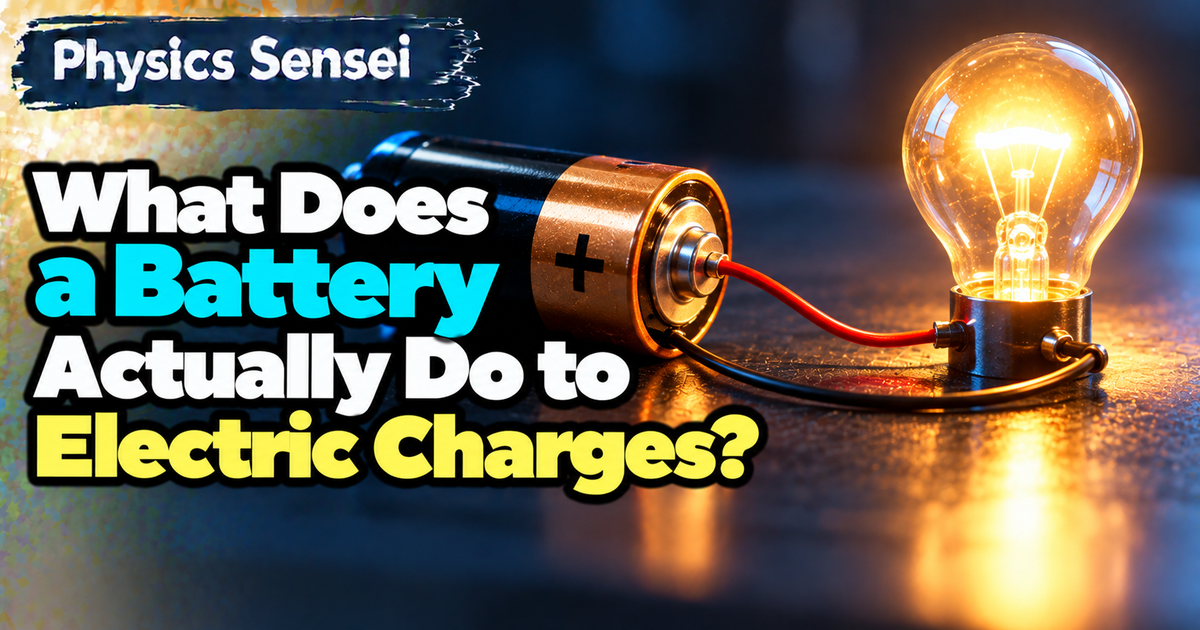
In a normal battery-and-bulb circuit, the bulb provides part of the resistance and uses electrical energy to produce light and heat. A short circuit creates another connection, often with much less resistance, that bypasses the bulb or another intended load.
Because the low-resistance path connects two points with a potential difference, a large current may flow through that path. A short does not mean electrons are moving a shorter distance; the important change is much less resistance.
Why does lower resistance mean more current?
For a circuit that can be approximated as ohmic, current depends on the applied voltage and the total resistance:
I = V/R
At a fixed 12 V, a 12 Ω total resistance corresponds to 1 A. Reducing total resistance to 1.2 Ω gives 10 A in the same idealized model. If resistance fell to 0.12 Ω, that model would predict 100 A.
These numbers illustrate the trend. They do not predict the actual current from an ordinary 12 V battery, because real batteries do not maintain an unchanged voltage at arbitrary currents.
Why can the wires get dangerously hot?
When current flows through a wire or connection with nonzero resistance, electrical energy is transferred to thermal energy. The heating rate for an ohmic section is
P = I2R
Large currents can therefore produce substantial heating even in low-resistance wiring, especially at imperfect contacts. Heat can damage insulation, melt conductors, or ignite nearby materials. Depending on the source and fault, sparks or arcs can occur too.
Does a short circuit create infinite current?
No. A real battery has internal resistance, and every wire and contact has some resistance. Sources also have practical current limits, and protective devices may interrupt a fault.
These effects keep current finite, but not necessarily safe. Some sources can deliver dangerous currents before a fuse or another protective device responds.
The takeaway
A short circuit can cause excessive current because it creates a very low-resistance path across a voltage source or around a load. The high current can cause severe heating and damage, even though real current is never literally infinite.
When This Breaks
The simple relationship I = V/R assumes a suitable ohmic model and an approximately fixed voltage. Real sources experience voltage changes under heavy load, and wire resistance may increase as the wire heats. Some circuits contain electronic current limiting or protection that changes the result.
Also, not every short circuit delivers the same current: the actual current depends on the source, the total fault-path impedance, and the response of protective equipment. This article describes the physical principle, not a procedure for testing electrical faults.
Keep Exploring: Current, Resistance, and Ohm’s Law
Want more practice connecting voltage, resistance, current, and power? Choose your Physics Sensei Unit Review for your course and available time.
Foundational Physics
Algebra-Based Physics
Calculus-Based Physics
Reviewed by Physics Sensei
Still stuck? Get unstuck. Choose the review that matches your course and the time you have.